 Canadian fulfilment · Free shipping $199+

A clear comparison
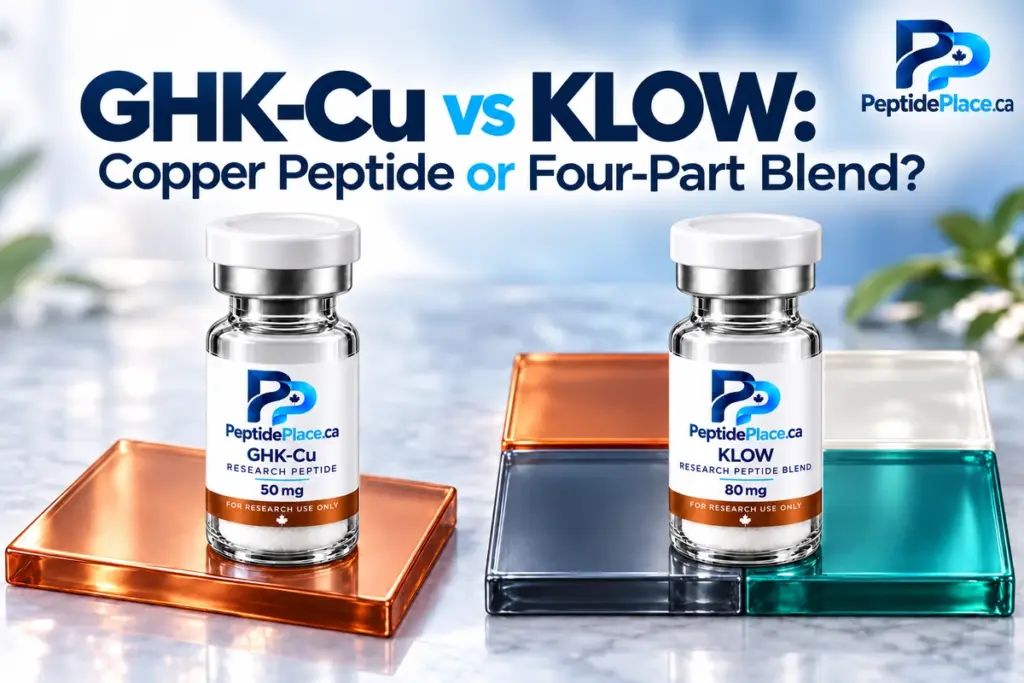
GHK-Cu is a copper peptide complex. KLOW is a blend containing GHK-Cu, BPC-157, TB-500 and KPV. Their listed total milligrams measure different compositions.
The differences at a glance
Reference facts and current product information are separate below. On a small screen, swipe within the table; keyboard users can focus it and scroll with the arrow keys.
| Compare | GHK-Cu | KLOW |
|---|---|---|
| Reference · material class | Copper peptide complex | Four-peptide blend |
| Reference · identity and composition | GHK-Cu. Supplied form and exact specification require matching documentation. | GHK-Cu + BPC-157 + TB-500 + KPV. Individual component quantities are unconfirmed. |
| Reference · research question | Skin, collagen & hair | Skin, repair & inflammation |
| Reference · evidence and limitations | Cosmetic formulation, concentration and route matter. Evidence about a finished topical product does not establish the performance of a catalogue research vial or of another preparation. | The listed 80 mg is the nominal total blend amount. Individual component quantities are not confirmed in this catalogue. Studies on separate ingredients do not establish the effect of this exact combination. |
| Reference · source papers | Maquart et al. (1988): GHK-Cu and collagen synthesis in cultured fibroblasts | See the ingredient-specific sources and limitations in the comparison. |
| Product · current sizes and prices | 50 mg · $54.99 In stock | 80 mg · $129.99 In stock |
| Product · current stock | In stock | In stock |
| Product · supplied specification | Confirm form, identity and specification for the selected size. A field not reported remains unconfirmed. Product specifications | Confirm form, identity and specification for the selected size. A field not reported remains unconfirmed. Product specifications |
| Product · matching lot records | No matching published record. Check Lab Results | No matching published record. Check Lab Results |
| Product · information and availability | View available options | View available options |
Product figures come from the current WooCommerce listing in the store currency. Package milligrams are nominal material amounts, not doses. No report for another sample or lot is substituted for a matching record.
A focused ingredient or a broader composition
GHK-Cu is often the first name people find when searching copper peptides, collagen, skin and hair research. KLOW adds three other named ingredients. This broadens the composition and the questions to ask about it. A four-component label does not establish four times the benefit, and the total blend amount does not reveal the amount of GHK-Cu.
Skin and collagen evidence
The cited foundational GHK-Cu paper describes collagen synthesis in cultured fibroblasts. It helps explain the link between copper-peptide research and skin-related interest. It does not test the current KLOW formulation. Finished cosmetics also differ in concentration, vehicle and use conditions, so cosmetic evidence should remain connected to the preparation that was studied.
What the numbers mean
The GHK-Cu listing has a nominal 50 mg package amount. KLOW has a nominal 80 mg total blend amount. The current catalogue does not confirm the quantity of each KLOW ingredient. It is therefore not possible to conclude that KLOW contains more copper peptide by comparing 80 with 50. The live table gives a product-price comparison without inventing that split.
Questions worth asking before comparing
For GHK-Cu, review the identity, copper specification and content basis. For KLOW, add the quantity of each component and any analytical method used to distinguish them. A chromatogram or a generic purity percentage should not be treated as a complete ingredient-by-ingredient content report. Follow the exact product and batch links for the available source information.
Common questions
Does KLOW contain GHK-Cu?
Yes. GHK-Cu is one of the four confirmed component names. Its individual amount is unconfirmed.
Can a KLOW vial be treated as a skincare product?
A research blend and a finished topical cosmetic are different preparations. The listing does not establish the performance of a cosmetic formula.
Original sources
These papers support the specific mechanisms or study models discussed above. They do not test the current Peptide Place catalogue batches.
Continue exploring
GHK-Cu: current options and full overview →