 Canadian fulfilment · Free shipping $199+

Compare with context
Compare Peptides
Review compound identities, research context and current product information side by side.
Selection changed. Choose Compare products to update the chart and product cards.
Research facts
Swipe the table horizontally, or focus it and use the arrow keys.
| Compare | BPC-157 | TB-500 | Wolverine |
|---|---|---|---|
| Reference · material class | Single peptide | Single peptide | Two-peptide blend |
| Reference · identity and composition | BPC-157. Supplied form and exact specification require matching documentation. | TB-500. Supplied form and exact specification require matching documentation. | BPC-157 + TB-500. Individual component quantities are unconfirmed. |
| Reference · research question | Recovery & gut | Repair & recovery | BPC-157 + TB-500 |
| Reference · evidence and limitations | Much of the repair literature comes from cells and animal models. A tendon-cell experiment can help explain a mechanism; it cannot establish a human recovery timeline. | TB-500 is a commercial name used for materials associated with thymosin beta-4. Published work on full-length thymosin beta-4 does not automatically apply to a fragment sold as TB-500. Check the supplied sequence. | The listed 20 mg is the nominal total blend amount. The ingredient split is not confirmed here, so it should not be assumed to contain 10 mg of each peptide. |
| Reference · source papers | Chang et al. (2011): BPC-157 and tendon fibroblast experiments | Esposito et al. (2012): analytical identification of the TB-500 fragment | See the ingredient-specific sources and limitations in the comparison. |
Current product information
Swipe the table horizontally, or focus it and use the arrow keys.
| Compare | BPC-157 | TB-500 | Wolverine |
|---|---|---|---|
| Product · current sizes and prices | 10 mg · $69.99 In stock | 5 mg · $49.99 In stock10 mg · $74.99 In stock | 10 mg · $79.99 In stock20 mg · $119.99 In stock |
| Product · current stock | In stock | In stock | In stock |
| Product · supplied specification | Confirm form, identity and specification for the selected size. A field not reported remains unconfirmed. Product specifications | Confirm form, identity and specification for the selected size. A field not reported remains unconfirmed. Product specifications | Confirm form, identity and specification for the selected size. A field not reported remains unconfirmed. Product specifications |
| Product · matching lot records | No matching published record. Check Lab Results | No matching published record. Check Lab Results | No matching published record. Check Lab Results |
| Product · information and availability | View available options | View available options | View available options |
Reference information does not verify a catalogue vial. Current sizes, prices and stock are shown in the product-information tab.
Your compared compounds
Explore the current products
These cards match the comparison above. Review available sizes and current stock before adding a product.
BPC-157
Tendon and ligament recovery, tissue repair and gut research, explained simply.
10 mg
In stock
TB-500
Tissue repair and recovery research. Compare it with BPC-157 and thymosin beta-4.
In stock
Wolverine
BPC-157 and TB-500 together in one blend for tissue-repair and recovery research.
In stock
Explore named comparisons
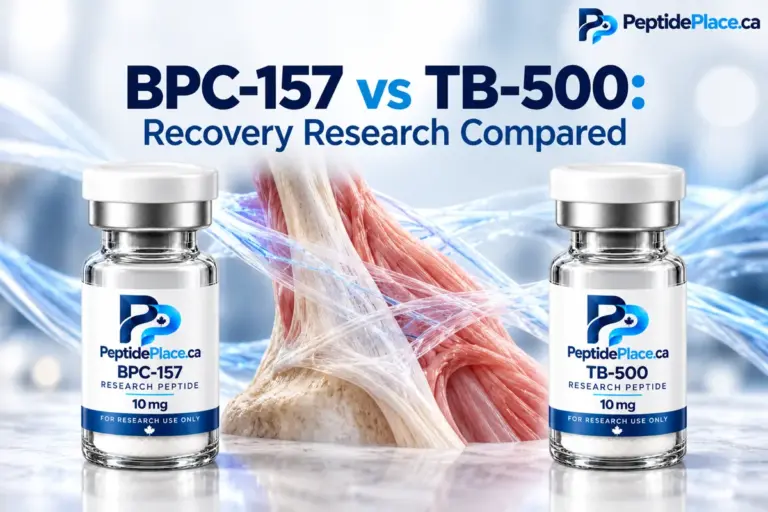 Side by side
BPC-157 vs TB-500: Recovery Research Compared
BPC-157 and TB-500 are different peptides that appear in recovery discussions. BPC-157 is associated with tissue-repair models; TB-500 requires careful distinction from full-length thymosin beta-4.
See the differences →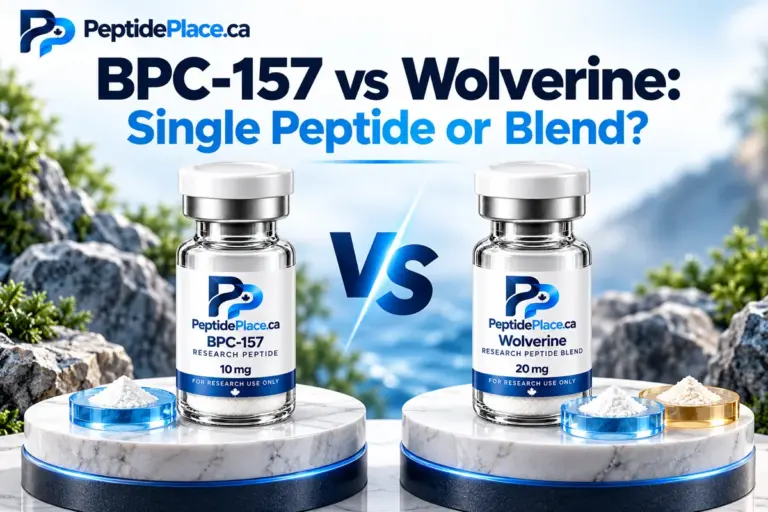 Side by side
BPC-157 vs Wolverine: Single Peptide or Blend?
BPC-157 is a single peptide. Wolverine is a named blend containing BPC-157 and TB-500. The main difference is composition, rather than a proven ranking for recovery.
See the differences → Side by side
Semaglutide vs Tirzepatide vs Retatrutide
Semaglutide targets GLP-1 receptors, tirzepatide targets GIP and GLP-1 receptors, and retatrutide targets GIP, GLP-1 and glucagon receptors. More targets alone do not establish a better result.
See the differences →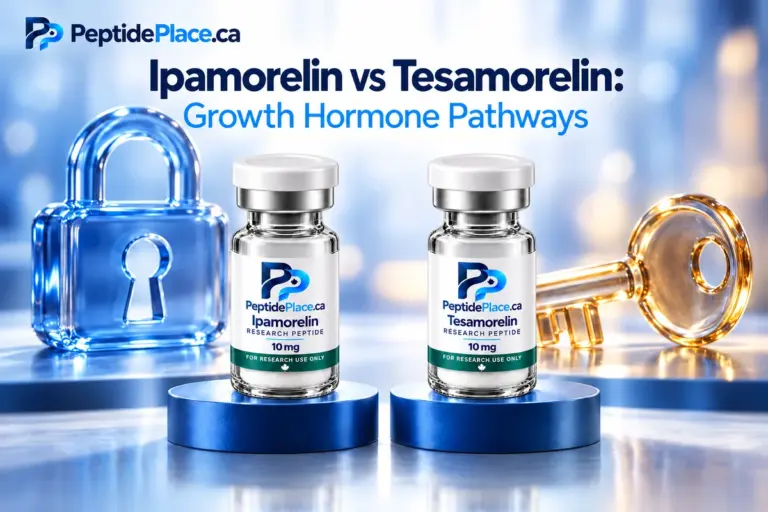 Side by side
Ipamorelin vs Tesamorelin: Growth Hormone Pathways
Ipamorelin and tesamorelin both relate to growth hormone release, through different receptors. Ipamorelin acts through the ghrelin receptor; tesamorelin is a GHRH analogue.
See the differences →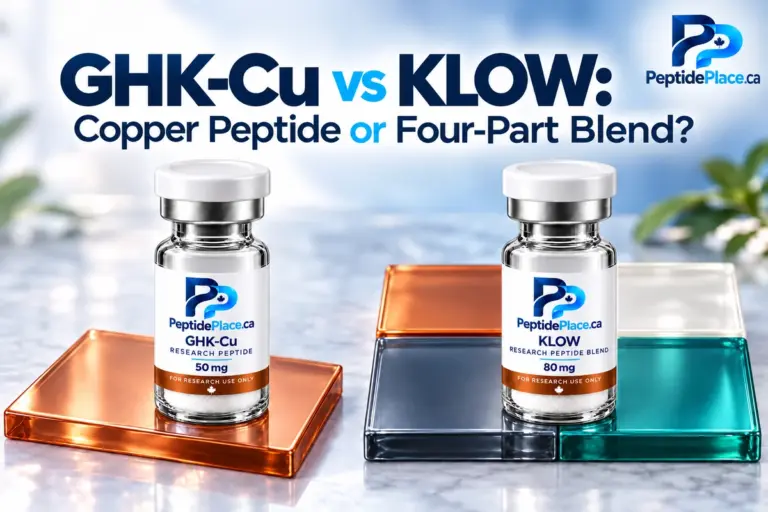 Side by side
GHK-Cu vs KLOW: Copper Peptide or Four-Part Blend?
GHK-Cu is a copper peptide complex. KLOW is a blend containing GHK-Cu, BPC-157, TB-500 and KPV. Their listed total milligrams measure different compositions.
See the differences →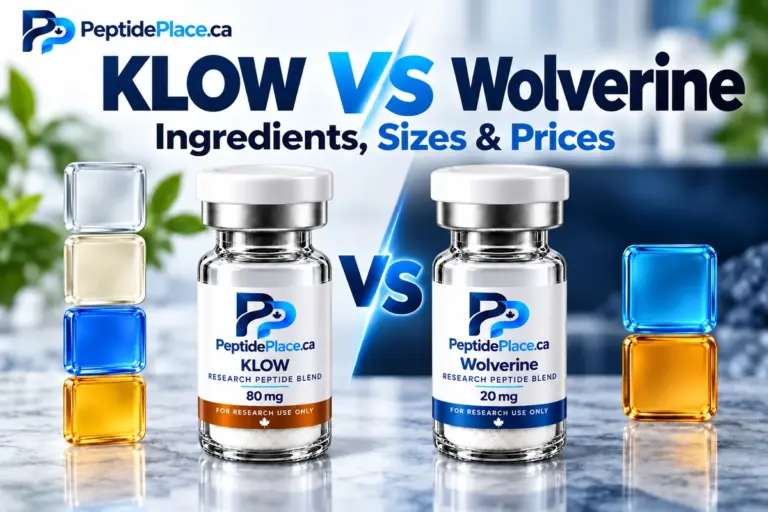 Side by side
KLOW vs Wolverine: Ingredients, Sizes & Prices
Wolverine combines BPC-157 and TB-500. KLOW contains those two ingredients plus GHK-Cu and KPV. Compare composition first, then total size, price and documentation.
See the differences →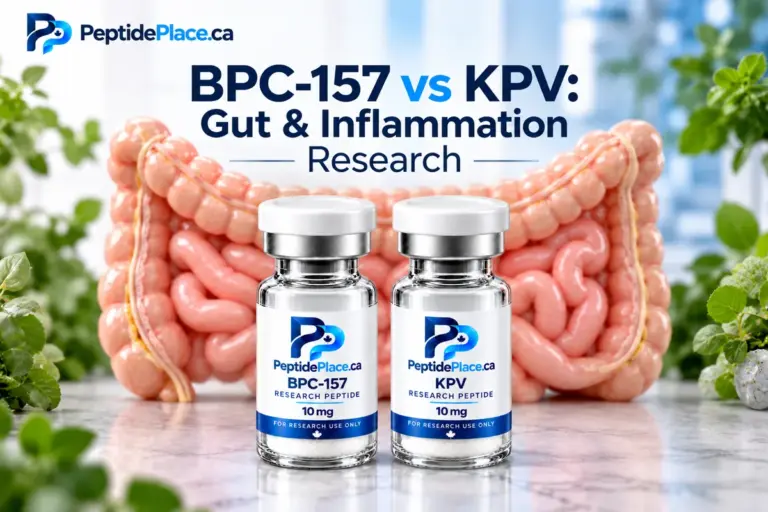 Side by side
BPC-157 vs KPV: Gut & Inflammation Research
BPC-157 and KPV both appear in gut-related searches, but they are different peptides. BPC-157 is discussed in tissue-repair models; KPV has foundational research on intestinal inflammatory signalling.
See the differences →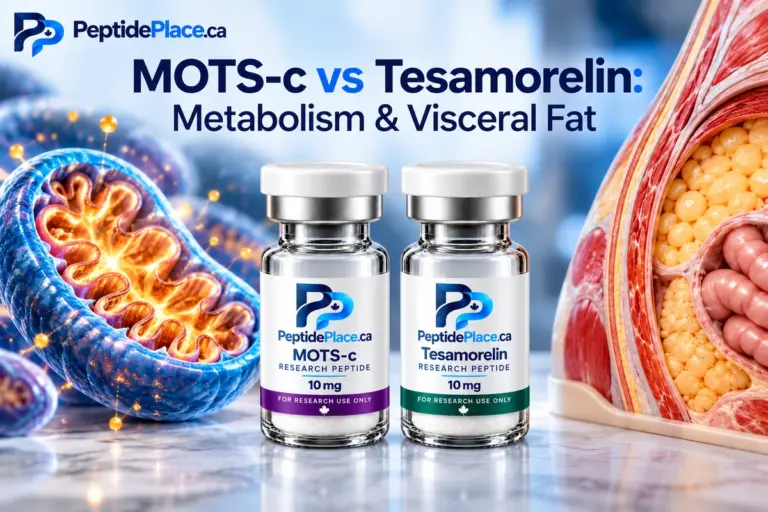 Side by side
MOTS-c vs Tesamorelin: Metabolism & Visceral Fat
MOTS-c and tesamorelin appear in metabolic discussions for different reasons. MOTS-c relates to mitochondrial signalling; tesamorelin relates to growth hormone release and visceral-fat research.
See the differences →Start with the exact compound, composition and study model. A shared research interest does not establish equivalent materials or outcomes.
How to read peptide research →Cellular metabolism comparison
NAD+ vs MOTS-c compares what researchers measured when studying a cellular coenzyme and a mitochondrial-derived peptide.
More compound comparisons
Choose a comparison by the question you need answered
Start with the difference you want to understand. A receptor comparison, an ingredient comparison and a laboratory-method comparison need different evidence. None of them requires an unsupported “best peptide” score.
| Your question | Useful comparison | Keep this distinction visible |
|---|---|---|
| How do two tissue-research names differ? | BPC-157 vs TB-500 | Resolve TB-500 structure before borrowing thymosin literature. |
| Is a copper peptide the same as a blend? | GHK-Cu vs KLOW | A single ingredient differs from a multi-ingredient preparation. |
| Which ingredients distinguish these blends? | GLOW vs KLOW | Confirm the exact formula; a blend name does not establish synergy. |
| Do metabolic compounds share one target? | Semaglutide, tirzepatide and retatrutide | Receptor overlap is not a head-to-head outcome comparison. |
| Are all growth-hormone research names equivalent? | CJC-1295 No DAC vs tesamorelin | Different structures and evidence cannot be merged by category. |
| Is NAD+ another mitochondrial peptide? | NAD+ vs MOTS-c | NAD+ is a coenzyme; MOTS-c is a peptide. |
| Which evidence question does a test answer? | HPLC vs LC-MS | Compare measured endpoints rather than imagined quality grades. |
If the question is how to compare the studies themselves, use the research evidence guide. If the names are unfamiliar, start with the compound research directory.