 Canadian fulfilment · Free shipping $199+

A certificate of analysis, or COA, is a lab report about a tested sample. Match the product and lot number first. Then read the identity, purity and content results separately.
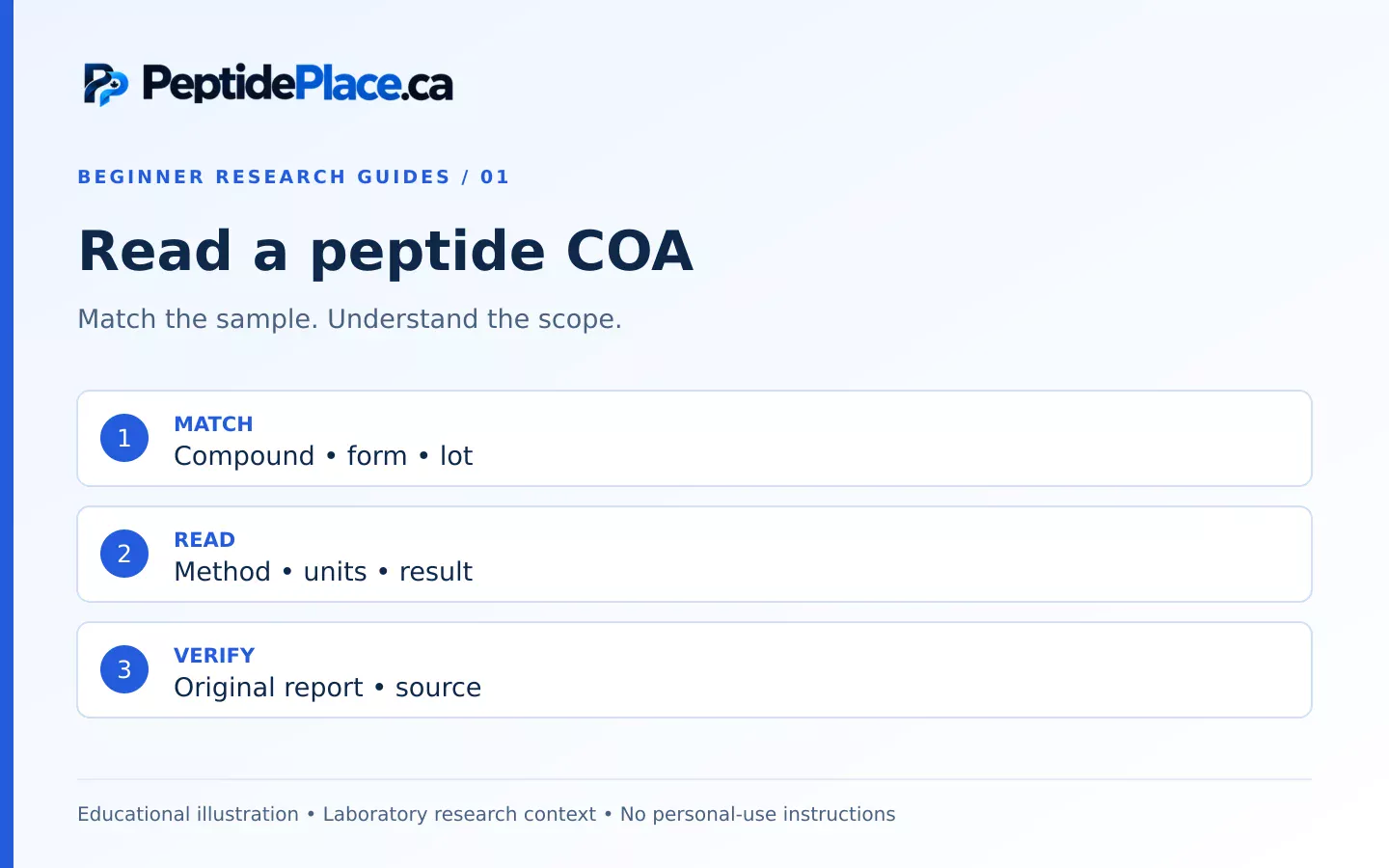
A useful COA review starts with the sample and batch identifiers, then checks each method and result separately. A prominent percentage is only one part of the record.
1. Match the product, size and lot
Begin with the physical label or the specific product option under review. Record the compound, nominal size, SKU and full batch code. Compare them with the report’s sample description. Similar names, a recent date or familiar packaging are not enough to establish a match.
For a variable product, select the size before reviewing its documentation. Retatrutide has several listed amounts, and a report assigned to one size should not silently stand in for the others. A shared parent page is a navigation convenience; it does not merge the analytical identities of its options.
Preserve the complete lot code, including letters, punctuation and leading zeros. If the label is unclear, ask for clarification rather than searching a shortened code and choosing the first plausible result. A precise identification question is easier to resolve than an assumption made later.
Apply this check on the Retatrutide product page or search the full code in Lab Results.
2. Open the original source document
Review the laboratory name, report identifier, sample reference, test date and complete pages. A clipped image may omit a footnote, sample-preparation detail or qualification that changes how a result should be read. Save the original file with your research records.
Distinguish the supplier’s summary from the issuing laboratory’s report. They should agree on the sample and findings, but a summary is not the primary document. If a link is broken or a report has been revised, request the current source and keep enough context to understand what changed.
Do not infer a testing partnership or accreditation from the style of a document. Any claim about the laboratory should be supported separately. The important first task is establishing the document’s origin and its connection to the submitted sample.
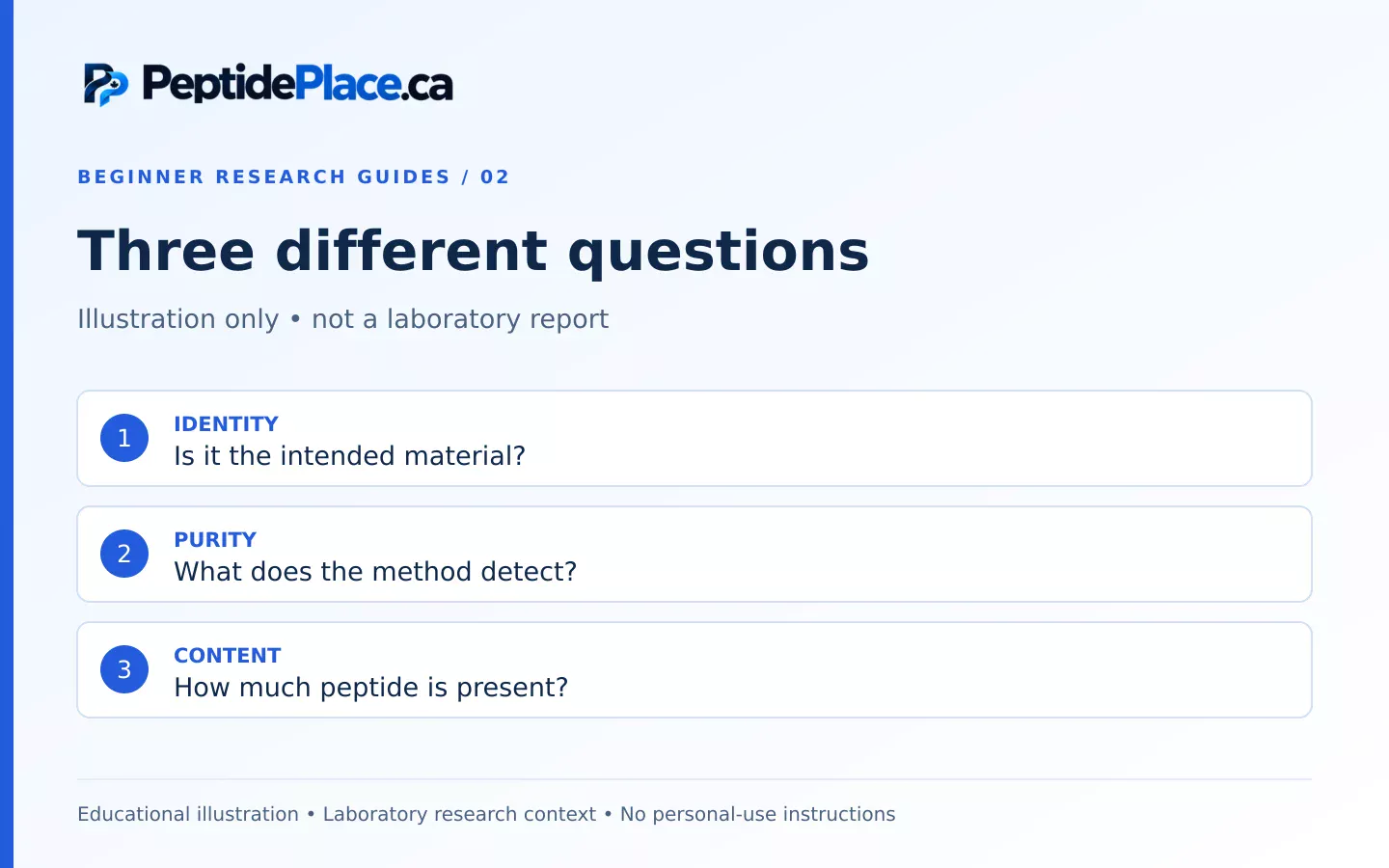
3. Read identity, purity and content separately
| Endpoint | Question answered | Details to inspect |
|---|---|---|
| Identity | Is the analytical finding consistent with the intended material? | Method, mass/structure information and stated conclusion |
| Chromatographic purity | How is the selected signal represented under this method? | Detector, integration, reporting basis and chromatogram |
| Measured content | What amount was determined? | Assay, calibration, units and sample basis |
| Other endpoints | Were additional questions actually tested? | Explicit methods and results for the named test |
The report may include only some of these endpoints. An empty or absent content result does not become a content assay because purity was measured. Likewise, identity evidence is not a broad statement about every contaminant or the suitability of a material for a particular application.
Treat each row as an independent claim that needs its own supporting method. This prevents a certificate’s overall professional appearance from doing more evidentiary work than the report itself.
4. Check the units and reporting basis
A result per vial, a concentration in a prepared sample and a relative peak-area percentage describe different quantities. Read the units before comparing the numbers. Ask what was weighed or prepared and what denominator the result uses.
Nominal package content is a listing statement. Measured content is an analytical finding. They can be placed beside one another for review, but they should remain labelled correctly. For mixtures, determine whether the report gives a result for each component or only a combined signal description.
More decimal places do not make a result more complete. First establish whether the endpoint and method answer your question. Precision-looking formatting cannot fill a missing assay, unclear sample identification or unstated reporting basis.
The purity versus content guide explains this distinction in detail.
5. Read chromatograms and mass information in context
Look for axes, method references, integration information and the laboratory’s stated interpretation. A single large peak can be visually reassuring while still leaving questions about co-elution, detection scope or the identification of smaller peaks.
Mass information can support identity assessment, but the conclusion depends on the data acquired and how it was interpreted. The instrument name alone does not state the scope of the test. Use the report’s actual wording and ask the laboratory about a conclusion that appears broader than the data shown.
You do not need to become an instrument specialist to recognise a documentation gap. A missing method, inconsistent identifier or unsupported summary is a clear question to raise. The next step is clarification, not guessing at a technical explanation from the shape of a graphic.
6. Separate a measured result from untested claims
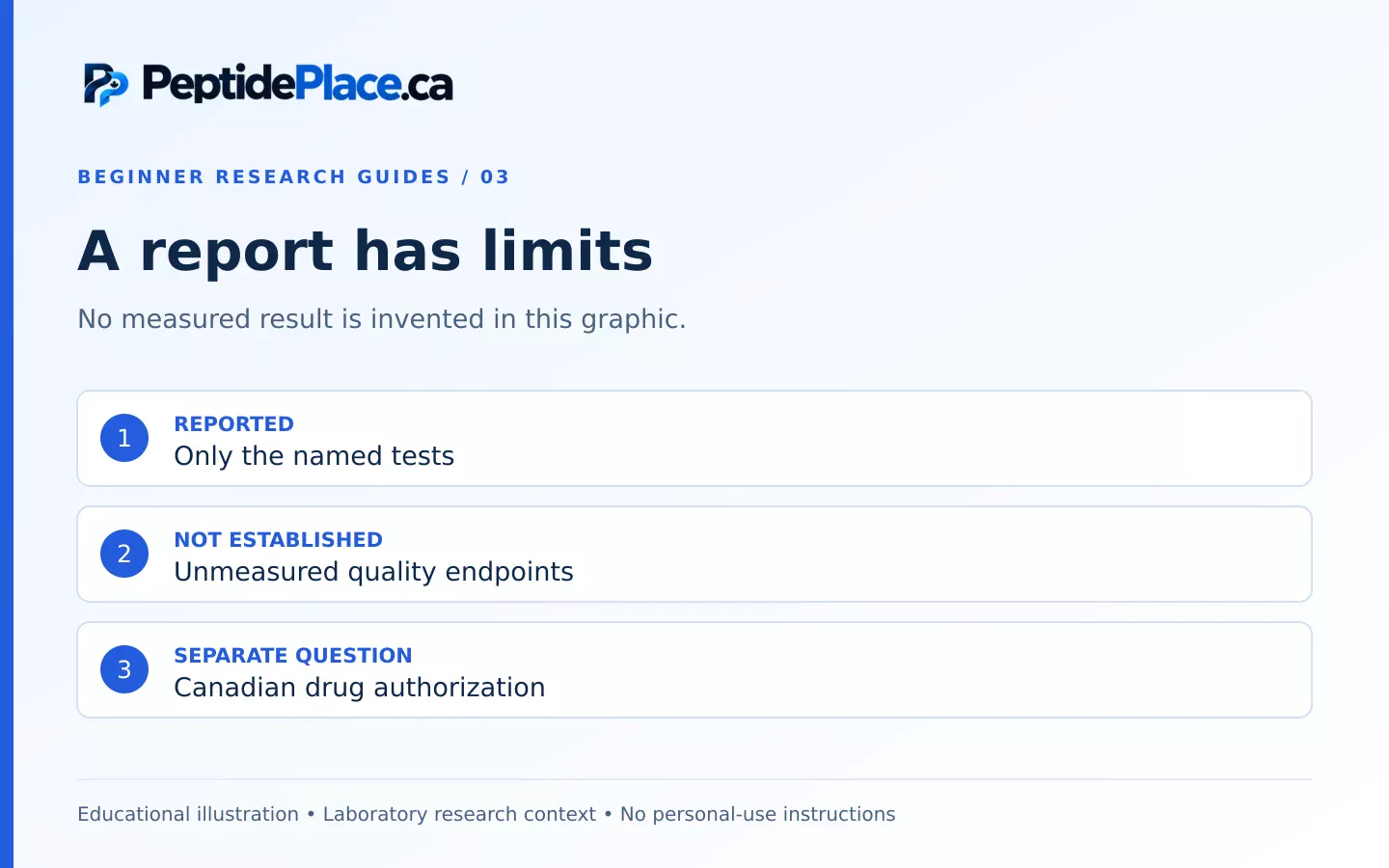
A report concerns its submitted sample and the tests performed. Purity alone does not establish sterility, endotoxin findings, biological effectiveness or clinical approval. These are different questions, each requiring appropriate evidence.
Also check time and version. A historical report can remain useful as an archive without establishing the findings for a newly received lot. When material is compared across batches, retain the earlier records so the relationship between samples remains clear.
Your COA review worksheet
- Product, selected size and SKU: recorded.
- Full lot code: matches the label and report.
- Issuing laboratory and report identifier: visible.
- Methods and units: readable for each endpoint.
- Identity, purity and content: separated in your notes.
- Untested endpoints and limitations: recorded explicitly.
- Original file: saved with the material’s records.
- Any mismatch: raised with support before relying on the finding.
For an enquiry, include those identifiers, the report link and the exact field that needs clarification. This is more useful than asking whether a product is simply “tested”. The Peptide Place documentation standard uses the same sequence of questions.
The seven checks
| Check | What to look for |
|---|---|
| 1. Report identity | Issuing laboratory, report identifier, date and complete document. |
| 2. Sample identity | Compound description, form and submitted-sample identifier. |
| 3. Batch match | The documented connection between the sample and your supplied lot. |
| 4. Methods | Named tests and enough method context to understand the results. |
| 5. Results | Values, units, qualifiers and stated acceptance criteria where supplied. |
| 6. Scope | Which endpoints were measured, and which were not. |
| 7. Verification | A reliable route to confirm the document and resolve discrepancies. |
This is an editorial checklist, not a claim that every report uses the same layout. The critical question is whether the document supports the claim being made about your material.
A fictional comparison: why the batch match comes first
Illustration only; these are not PP reports. Report A names Compound Q, lot Q-101. Your vial is Compound Q, lot Q-204. Report B names the same lot as your vial but lacks the analytical page you need. Neither gap disappears because a website displays an impressive percentage.
| Situation | What the available evidence supports | Next question |
|---|---|---|
| Different lot | A result about another identified sample | Where is the record linking this report to the supplied lot? |
| Incomplete report | Only the visible pages and stated tests | Can the complete original document be supplied? |
| No sterility test shown | No sterility result established by this report | Was that endpoint tested, by which method and on what sample? |
Keep unresolved questions attached to the record. A screenshot without its report identifier is difficult to verify later.
What “independent testing” needs to explain
Ask who performed the testing, which sample they received, what they tested and how the result connects to the supplied lot. An independent laboratory name alone does not describe sample collection or establish chain of custody.
If a laboratory offers a verification service, use its genuine official channel. Avoid treating an unrelated logo, a QR code or a vendor-created badge as verification. A QR destination should lead to the expected source, and the document should match the product under review.
Frequently asked questions
Does a COA with high purity prove sterility?
No. A result supports its named endpoint and method. Sterility and endotoxin questions require their own appropriate tests.
Can I use a certificate from another batch?
Keep it as historical information, but do not treat it as a finding for a different lot without documented justification.
What if there is no matching report?
Ask for the exact source record. The absence of a report is not itself a measured result.
Sources and further reading
Technical sources support the analytical concepts; scientific findings belong to their stated study models. Examples and review worksheets in this guide are educational tools, not Peptide Place batch results.
Editorial and corrections policy · Report a factual or documentation issue
Put the explanation into practice
Choose one compound and check its name, current sizes and research summary. Then compare a related compound before opening a source report. BPC-157 and TB-500 provide a useful recovery comparison; GHK-Cu introduces the skin and collagen conversation. For different metabolic pathways, compare Retatrutide and MOTS-c.
Open the comparison tool or return to the beginner learning path.
Evaluating a research supplier? Use the Canadian supplier checklist.
Working with entered mass and volume? Use the Research Tools calculators.
Additional technical sources
Read the dates as a timeline, not an expiry promise
A date of analysis tells you when a test was carried out. It does not automatically tell you when the material was made, received by the laboratory, released by the supplier or last checked after storage. These can be separate dates. Write down what each date is labelled before drawing a conclusion from it.
A retest date means the material is due for another assessment under a defined system. An expiry date is a different statement. Neither should be invented by adding a fixed number of months to the test date. If a source document supplies one of these dates, keep its conditions and wording with the record.
When a report says “passes”
Find the acceptance criterion, the rule used to decide whether a result is acceptable. “Pass” without a named test or criterion leaves an important gap. A numerical result should retain its units, reporting basis and any qualification. A result below a method’s reporting limit is not automatically proof that a substance is completely absent.
The ICH Q7 guidance published by the FDA describes certificates in an active-pharmaceutical-ingredient manufacturing context, including batch identification, tests, limits and results. It is a useful reference for document fields, not evidence that a research-material supplier or a particular PP lot meets that manufacturing standard.
Two separate questions about the laboratory
First ask whether the laboratory issued this specific report. Then ask whether any claimed accreditation covers the relevant test. ILAC’s directory guidance helps locate the appropriate accreditation body. An authentic report and an accredited method are related checks, but one does not establish the other.
For the source-authentication steps, use how to verify a peptide lab report. For the meaning of a result, compare purity, measured content and label amount. Keep unresolved fields attached to the report instead of filling them with assumptions.
Peptide batch numbers: which code should match?
A batch or lot number connects material to a production or handling record. A laboratory sample number connects a submitted sample to the laboratory’s record. A report number identifies the issued document. These codes can be different while still being linked by clear documentation.
| Code or date | What it identifies | What it cannot establish alone |
|---|---|---|
| Product SKU | A catalogue option. | That two vials came from the same lot. |
| Batch or lot | A defined material record. | That every relevant property was tested. |
| Laboratory sample ID | The sample received by the laboratory. | Its relationship to your vial without a documented link. |
| Report ID / revision | The particular issued report and version. | That an older screenshot is the current complete report. |
| Analysis date | When the stated analysis took place. | A supported expiry or universal storage period. |
Keep the complete codes, including prefixes and punctuation. If a label and report disagree, ask for the traceable relationship rather than accepting a similar-looking number. A revised report should explain its relationship to the earlier version; retain that history when comparing records.
This is a document-reading checklist, not a statement that a particular Peptide Place lot passed an unreported test. Open the actual lab-results record for a sample-specific question, or use the quality and testing FAQ for a short explanation.