 Canadian fulfilment · Free shipping $199+

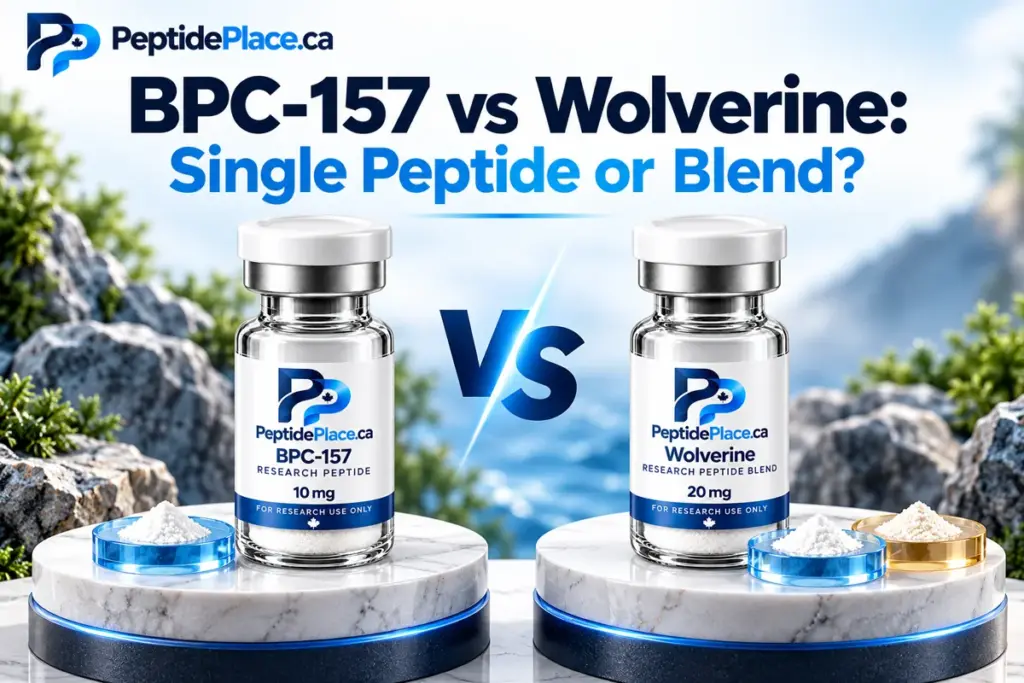
A clear comparison
BPC-157 is a single peptide. Wolverine is a named blend containing BPC-157 and TB-500. The main difference is composition, rather than a proven ranking for recovery.
The differences at a glance
Reference facts and current product information are separate below. On a small screen, swipe within the table; keyboard users can focus it and scroll with the arrow keys.
| Compare | BPC-157 | Wolverine | TB-500 |
|---|---|---|---|
| Reference · material class | Single peptide | Two-peptide blend | Single peptide |
| Reference · identity and composition | BPC-157. Supplied form and exact specification require matching documentation. | BPC-157 + TB-500. Individual component quantities are unconfirmed. | TB-500. Supplied form and exact specification require matching documentation. |
| Reference · research question | Recovery & gut | BPC-157 + TB-500 | Repair & recovery |
| Reference · evidence and limitations | Much of the repair literature comes from cells and animal models. A tendon-cell experiment can help explain a mechanism; it cannot establish a human recovery timeline. | The listed 20 mg is the nominal total blend amount. The ingredient split is not confirmed here, so it should not be assumed to contain 10 mg of each peptide. | TB-500 is a commercial name used for materials associated with thymosin beta-4. Published work on full-length thymosin beta-4 does not automatically apply to a fragment sold as TB-500. Check the supplied sequence. |
| Reference · source papers | Chang et al. (2011): BPC-157 and tendon fibroblast experiments | See the ingredient-specific sources and limitations in the comparison. | Esposito et al. (2012): analytical identification of the TB-500 fragment |
| Product · current sizes and prices | 10 mg · $69.99 In stock | 10 mg · $79.99 In stock20 mg · $119.99 In stock | 5 mg · $49.99 In stock10 mg · $74.99 In stock |
| Product · current stock | In stock | In stock | In stock |
| Product · supplied specification | Confirm form, identity and specification for the selected size. A field not reported remains unconfirmed. Product specifications | Confirm form, identity and specification for the selected size. A field not reported remains unconfirmed. Product specifications | Confirm form, identity and specification for the selected size. A field not reported remains unconfirmed. Product specifications |
| Product · matching lot records | No matching published record. Check Lab Results | No matching published record. Check Lab Results | No matching published record. Check Lab Results |
| Product · information and availability | View available options | View available options | View available options |
Product figures come from the current WooCommerce listing in the store currency. Package milligrams are nominal material amounts, not doses. No report for another sample or lot is substituted for a matching record.
What is actually in each listing?
The BPC-157 product is listed by its single compound name and nominal package amount. Wolverine lists two ingredients and a nominal total blend amount. The total on the blend is not a separate amount for each ingredient. The current catalogue does not confirm a ratio, so a 20 mg Wolverine listing cannot be treated as 20 mg BPC-157 or as an assumed equal split.
Why the comparison matters
People exploring healing and recovery often reach the blend after reading about BPC-157. A more useful question than which is stronger is what information each listing makes available. Compare the named identity, ingredient quantities, size, SKU and matching source report. Extra components create extra information needs; they do not automatically create better evidence.
Comparing price fairly
The table shows current product prices and nominal package sizes. For a single compound, price per nominal milligram can help compare sizes of that same product. Across a blend and a single compound, that calculation has a different meaning. You cannot infer the price per milligram of BPC-157 inside Wolverine until its BPC-157 quantity is established.
Reading recovery evidence
Evidence about BPC-157 or thymosin beta-4-related materials should be read at ingredient level first. Then ask whether a study tested the exact combined formulation. The tendon paper below does not test this Wolverine product. Keep its findings connected to the actual experimental material and model rather than transferring the results to the blend.
Common questions
Does Wolverine contain BPC-157?
Yes. The confirmed component list is BPC-157 and TB-500. Their individual quantities remain unconfirmed.
Is the 20 mg amount a dosage?
No. It is the nominal total package amount listed for the blend.
Original sources
These papers support the specific mechanisms or study models discussed above. They do not test the current Peptide Place catalogue batches.
- Chang et al. (2011): BPC-157 and tendon fibroblast experiments ↗
- Esposito et al. (2012): analytical identification of the TB-500 fragment ↗
Continue exploring
BPC-157: current options and full overview →
Wolverine: current options and full overview →