 Canadian fulfilment · Free shipping $199+

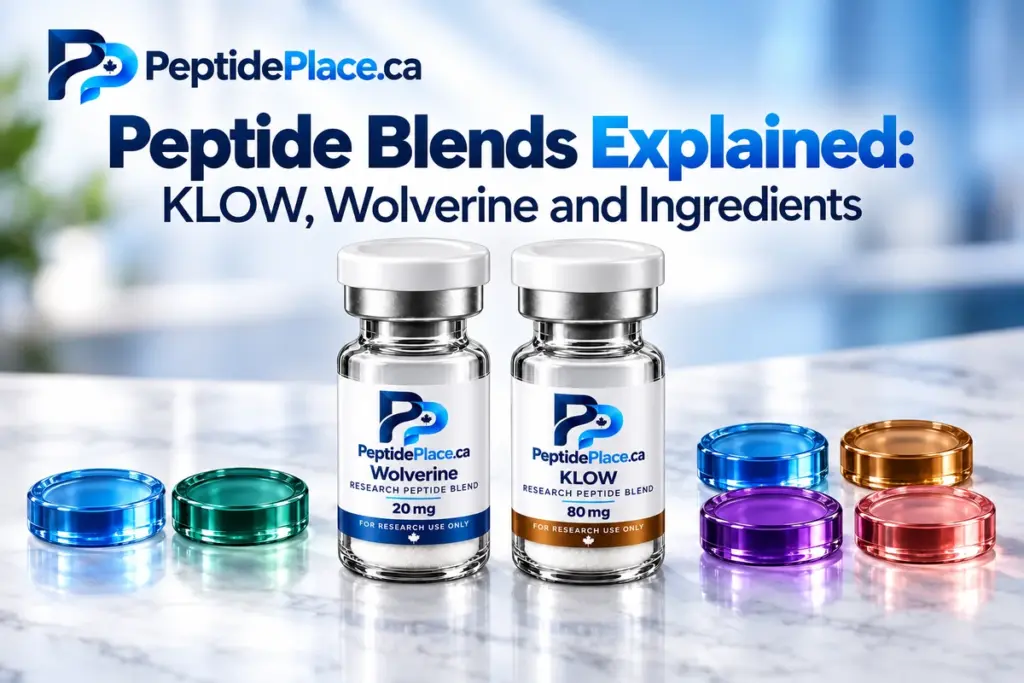
A peptide blend combines more than one named ingredient. Start with the ingredient list and the amount of each component, then compare the research behind the ingredients with any evidence about the exact blend.
A blend name does not provide a complete formula. Identify each ingredient, its confirmed quantity and form, and the finished mixture’s analytical documentation before comparing it.
The confirmed Peptide Place blend listings
| Blend | Listed nominal total | Confirmed ingredient names |
|---|---|---|
| KLOW | 80 mg | GHK-Cu, BPC-157, TB-500 and KPV |
| Wolverine | 20 mg | BPC-157 and TB-500 |
These entries establish the confirmed names and listed totals supplied for the catalogue. They do not establish the individual contribution of each component, an equal split or a particular chemical form. Those details require their own supplier confirmation.
A trade name is a practical label for finding a product. It is not a universal scientific formula shared by every supplier. When comparing blends across sources, write down the actual composition rather than assuming a matching name means an identical preparation.
Open KLOW or Wolverine to review the current listing and documentation status.
Why a total does not reveal the ratio
A total amount gives one aggregate figure. It cannot uniquely determine the quantities of several components. Dividing evenly by the number of ingredients would create an unconfirmed formula rather than recover a known one.
The same problem applies to familiar-looking blend names. A ratio copied from another source may describe a different product. Preserve the uncertainty until the actual formulation is supplied, including how each amount is defined.
For a useful comparison, ask for every component’s nominal quantity, chemical form and reporting basis. Check whether the stated total refers to peptide amounts, a complex or the finished preparation. If those meanings differ between listings, the totals are not yet a fair basis for comparison.
Each component needs its own identity record
The blend contains more than one material description. Record the exact identity of each component before borrowing chemistry or evidence from a standalone product. An unresolved component identity remains unresolved when that component is placed in a mixture.
TB-500 is a particularly important check because a fragment and full-length thymosin-related material should not be treated as the same structure. GHK-Cu also needs a clear copper-associated specification and content basis. A finished-blend name does not remove either question.
Do not assign one sequence, one molecular formula or a borrowed CAS number to the entire mixture as though it were a single molecule. A composition record is more useful than a technically impressive field that describes only one ingredient.
- Check TB-500 identity documentation
- Check GHK-Cu form and copper specification
- Use the specification worksheet
Ingredient studies and combination studies differ
A paper about an isolated ingredient answers a question about the material and conditions used in that study. It does not automatically establish the properties of the combination. Adding another ingredient changes the experimental situation.
A claim of synergy is stronger than saying several compounds were present together. It needs an appropriate comparison and defined analysis. An observation with the blend alone may not identify which component contributed or whether the combination adds anything beyond individual effects.
Keep those distinctions visible when reading blend descriptions. A collection of references can provide background on ingredients while leaving the finished mixture’s effect, stability or compatibility unanswered. Quantity and identity information also matter for reproducing any comparison.
What a blend COA should help you evaluate
First match the finished product and lot. Then look for how the laboratory identifies the claimed components and what is actually quantified. A result from a bulk ingredient may contribute to traceability without being the same as testing the finished mixture.
Read how chromatographic signals are assigned and what reporting basis is used. A single large percentage is not enough to understand every question in a multi-component preparation. Ask whether each target component has an identity finding and, where claimed, a content result.
Detector response should not be assumed identical across different components without a justified method. The presence of several compatible signals is not automatically a measurement of the milligrams contributed by each ingredient.
| Question | Documentation to request |
|---|---|
| Are the ingredients present as claimed? | Component-specific identity findings and methods |
| How much of each is supplied? | Confirmed formulation and suitable quantitative results |
| Does the report cover the finished blend? | Sample description and traceable lot relationship |
| How is purity expressed? | Peak assignment, denominator and method scope |
| What remains untested? | Explicit limitations and missing endpoints |
Finished-formulation handling needs its own basis
Handling guidance for an individual ingredient does not automatically validate a mixture’s conditions or stability period. Request information that applies to the finished blend in its supplied form.
Maintain the formulation version alongside the lot record. If a component’s identity or contribution changes, a repeated trade name can conceal a meaningful material change. Comparisons across lots need enough documentation to detect that possibility.
This guide does not supply a mixing recipe, administration schedule or personal-use protocol. Its purpose is to help you review the composition and analytical record of an existing research-material listing.
Continue with storage and handling documentation for the sample-record workflow.
A blend comparison worksheet
- Trade name and supplier.
- Finished-product SKU, size and full lot code.
- Each ingredient’s exact identity and form.
- Each confirmed quantity and content basis.
- Total nominal amount and how it is calculated.
- Finished-mixture source report and methods.
- Separate component evidence versus blend evidence.
- Handling documentation for the actual formulation.
- Unconfirmed fields and the supplier response needed.
Use the worksheet before comparing price. A lower total price does not resolve an unknown formula, and a higher total amount does not reveal the composition. A clear set of fields gives you a more useful comparison and a more precise support enquiry.
Frequently asked questions
Is Wolverine always an equal BPC-157/TB-500 split?
No ratio should be assumed from the name or total. Confirm the actual supplied composition.
Does KLOW’s total establish all four component amounts?
No. The ingredient names and total leave multiple possible formulas. Individual quantities need confirmation.
Can separate ingredient COAs replace a finished-blend report?
They may support traceability, but the finished mixture and its claimed endpoints require their own documented sample relationship and evidence.
Sources and further reading
Technical sources support the analytical concepts; scientific findings belong to their stated study models. Examples and review worksheets in this guide are educational tools, not Peptide Place batch results.
Editorial and corrections policy · Report a factual or documentation issue
Put the explanation into practice
Choose one compound and check its name, current sizes and research summary. Then compare a related compound before opening a source report. BPC-157 and TB-500 provide a useful recovery comparison; GHK-Cu introduces the skin and collagen conversation. For different metabolic pathways, compare Retatrutide and MOTS-c.
Open the comparison tool or return to the beginner learning path.
Peptide blends versus single compounds: compare the research question
A single-compound study can make it easier to attribute an observed change to a defined material. A blend changes more than one ingredient at once. That can be a valid experimental question, but it needs a design that can separate the claims being made about the combination.
What would establish an added combination effect?
Start by asking whether the study compared the mixture with its individual components and a suitable control. A result for the mixture alone may show an observation under those conditions without showing which ingredient contributed. “More effective together” and “different from a control” are not interchangeable conclusions.
Synergy is an even more specific claim: the combined result must be judged against a defined expectation for the components. A paper should state the comparison and analysis used. Adding separate ingredient references to a blend page does not supply that missing experiment.
Keep identity and formulation fixed
Use the actual stated composition when comparing studies or lots. If quantities, chemical forms or ingredients differ, describe the difference. For KLOW, Wolverine and GLOW, the name helps you locate the listing; the current formulation record establishes what is being compared. This section does not introduce or confirm a component ratio.
A finished-mixture analytical method also needs to distinguish the intended targets in the presence of the other ingredients. The ICH validation framework describes interference as a method-performance question. A component identity result and its quantitative amount remain separate findings.
Continue with BPC-157 versus Wolverine for a named single-versus-blend comparison, or GLOW versus KLOW for two blend labels. Use the study-comparison method before transferring a component finding to a finished formula, and the storage guide when formulation-specific handling is the question.
For the compound-background record behind the trade name, read the Wolverine research profile alongside the finished-blend checklist.
Follow the ingredient evidence before comparing a blend
Use the compound directory to find each named ingredient and the source trail behind its research. Then compare GLOW with KLOW or BPC-157 with Wolverine using the exact formula. The directory labels mixtures separately so a blend is not assigned a borrowed sequence, molecular weight or study result.
Explore this topic further
- KLOW vs Wolverine: Ingredients, Sizes & Prices
- KLOW
- Wolverine