 Canadian fulfilment · Free shipping $199+

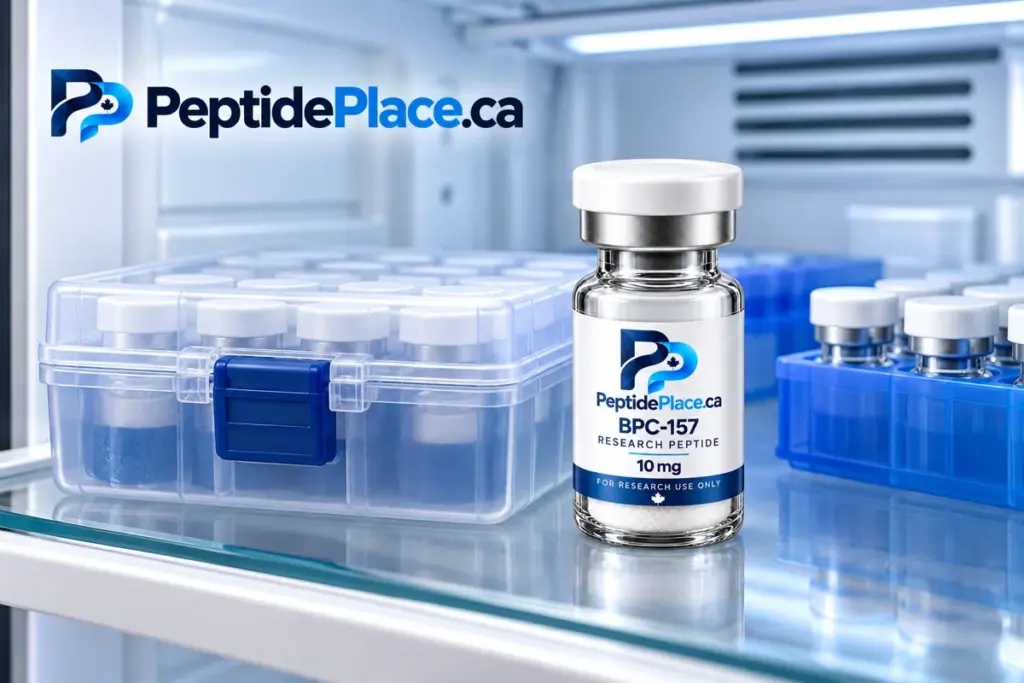
Good storage starts with the instructions for the material you actually have. Keep its label, lot number and documented storage conditions together so you can trace what happened from receipt onward.
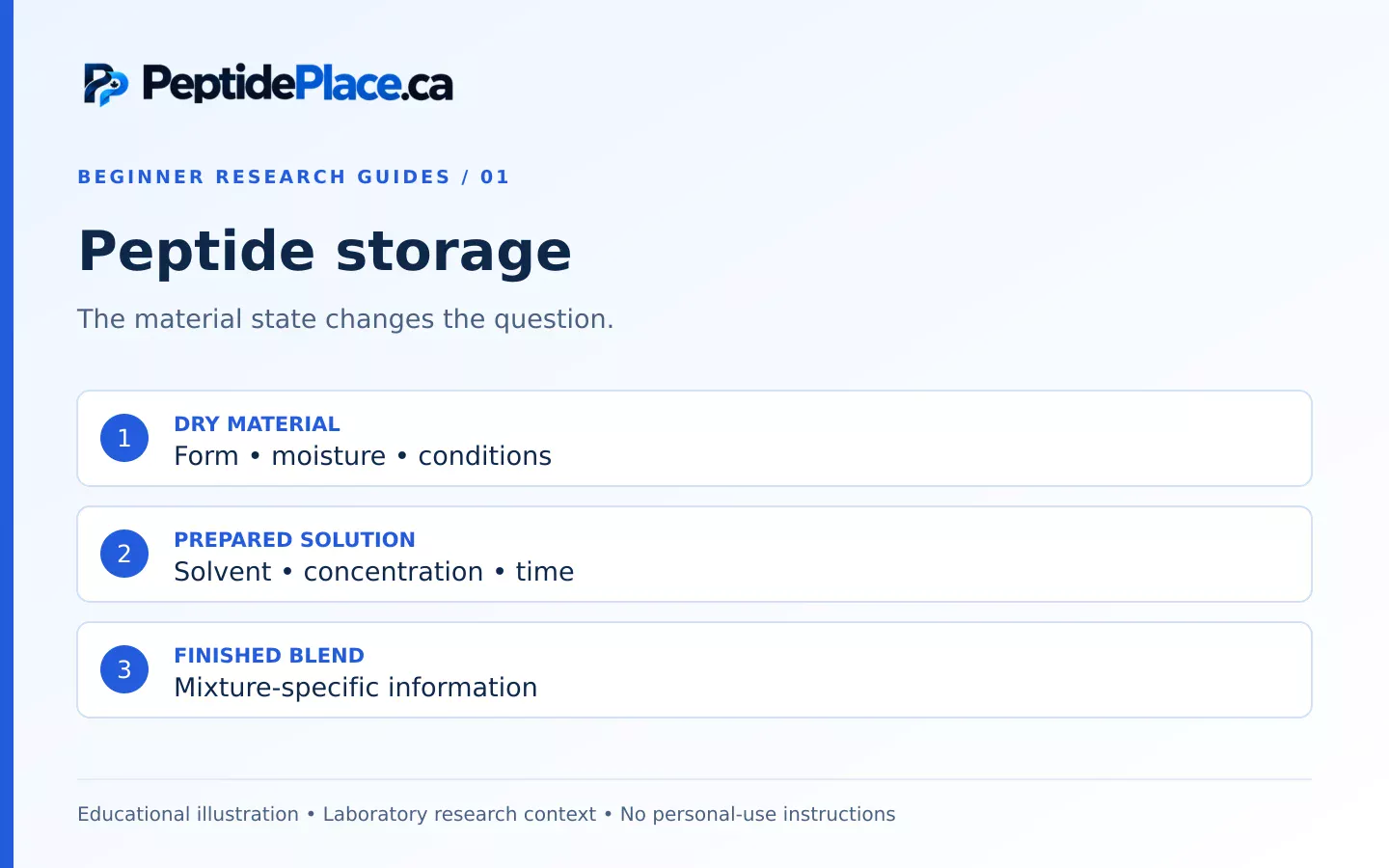
Storage guidance belongs to the actual material, formulation and conditions. Start with its documented specification and your laboratory’s procedures, rather than a universal chart copied from another product.
What a storage instruction needs to identify
A meaningful storage statement names the material and the conditions to which it applies. A dry preparation and a solution are different situations. Formulation, container, concentration and handling history can also matter when interpreting a stability claim.
The practical first step is to obtain the supplier’s specification for the supplied form. Ask which document supports it and whether the guidance changes after the material is opened or prepared for laboratory work. Keep that answer attached to the exact product and lot record.
A broad internet rule may omit important conditions. It can suggest a question to ask, but it should not silently replace product-specific evidence. If the relevant limits are not available, record the gap and request clarification before building a protocol around an assumption.
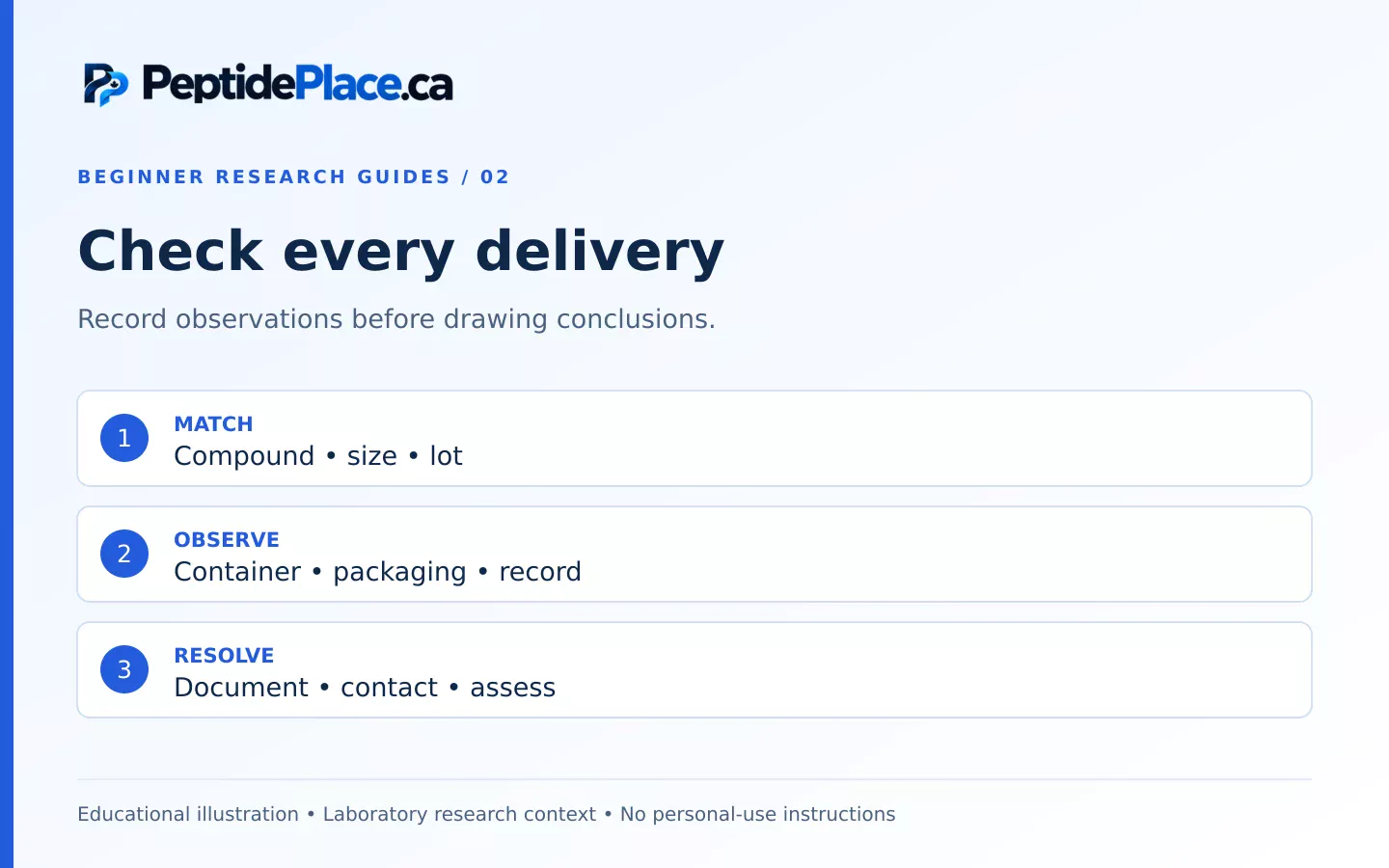
A useful receipt check
- Compare the order with the delivered compound and nominal size.
- Read and retain the lot code and any accompanying handling document.
- Check the condition of the outer packaging and product container.
- Record the receipt date and any observed discrepancy.
- Locate the matching source report where published.
- Contact support if damage, identity or documentation is unclear.
A receipt record is useful because it preserves observations made at the time. Avoid reconstructing conditions from memory after a question appears weeks later. Relevant photographs can document a packaging issue, but photographs do not measure stability or establish the material’s analytical properties.
If a shipment appears compromised, keep the material and packaging together while seeking clarification. Do not decide that the sample is acceptable solely because the powder looks unchanged.
Build a sample record that stays connected
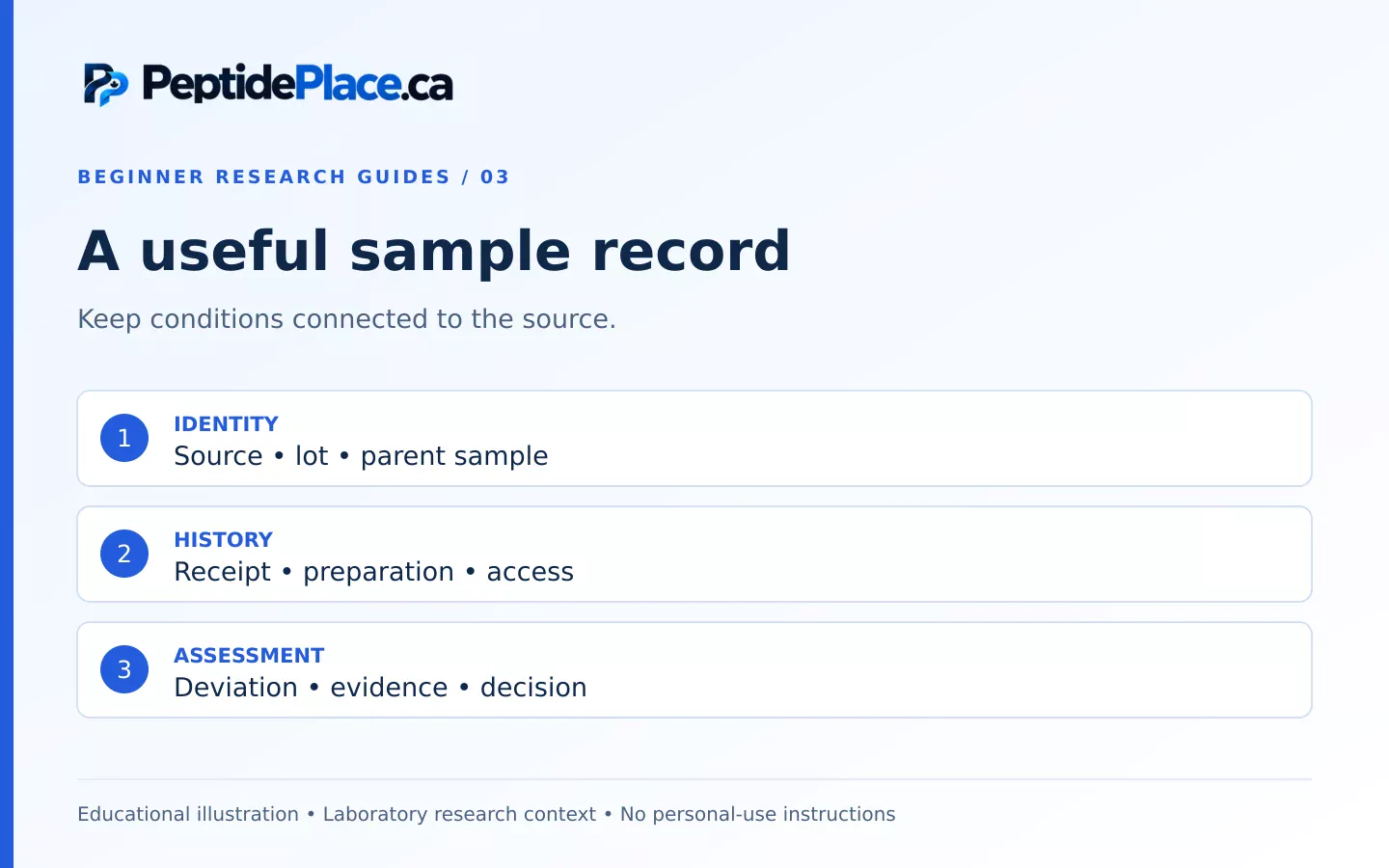
Give the material a laboratory record that links the supplier, product, size, SKU, lot, receipt and source files. Record the storage specification and where it came from. When the material is prepared or divided, retain the relationship between the resulting portions and the original sample.
Your institution’s procedures should determine the handling detail needed for the actual work. The value of a record is that another reviewer can understand what happened without guessing. A folder of disconnected screenshots makes that harder than a clear sample record with the original documents.
Separate an observation from a conclusion. “Package arrived with visible damage” is an observation. “The material is stable despite damage” requires evidence beyond that observation.
| Record item | Why it helps |
|---|---|
| Original product and lot | Maintains identity across files and portions |
| Supplied form and specification | Shows which handling guidance applies |
| Receipt and preparation history | Preserves the material’s timeline |
| Source report and version | Connects measurements with the correct sample |
| Deviation and follow-up | Records what needed clarification and how it was addressed |
Do not transfer guidance between different forms
A storage statement for a dry material does not automatically provide conditions for a prepared solution. Likewise, information about an isolated component does not establish the finished blend’s behaviour. The relevant document needs to describe the form actually being handled.
This guide deliberately does not provide a universal reconstitution recipe, solvent or expiry period. Those choices should follow the material’s documentation and a suitable laboratory protocol. A familiar compound name is not enough to determine all of them.
When comparing sources, check whether they describe the same identity and formulation. Apparent disagreement may reflect different materials or conditions rather than a simple choice between one correct temperature and another.
Plan repeated handling before it happens
Think through how often the sample will be accessed, what records each step requires and how the laboratory will preserve traceability. If your protocol uses aliquots or repeated measurements, document their relationship to the parent sample and the conditions relevant to the method.
The goal is not to add paperwork for its own sake. It is to prevent uncertainty about which material produced a result. A short, consistent record can be more useful than a long narrative written after the experiment.
Ask what evidence would be needed if a handling condition changed. If a limit is central to the work, clarify it before treating a generic handling suggestion as a validated stability statement.
Extra questions for mixtures and special forms
For KLOW or Wolverine, request guidance for the finished mixture, not only the ingredients separately. Component documentation is relevant background, but it does not establish every property of the combination.
For GHK-Cu, the supplied copper-associated form and content basis should remain part of the record. For TB-500, clarify the actual peptide identity before borrowing a handling statement from thymosin-related literature.
A concise supplier request
Include the compound, nominal size, SKU, lot and supplied physical form. Ask for the storage specification, its scope, any supported handling limits and the relevant safety or stability documentation. If an issue occurred during delivery, describe what was actually observed.
Retain the answer with the source specification rather than copying one isolated sentence into a notebook. The context is part of the guidance.
Use Contact for product-specific documentation, Shipping & Ordering for delivery information and the specifications guide to organise the resulting fields.
Read the storage instruction in full
| Field | Question to resolve |
|---|---|
| Material | Does this identify the exact compound and supplied form? |
| Conditions | Are temperature, light and moisture requirements stated? |
| State | Does the instruction apply unopened, after opening or after solution preparation? |
| Time | Is a supported period specified for those conditions? |
| Evidence | Which specification or study supports the instruction? |
A temperature without a stated material state leaves a practical gap. A period without conditions has the same problem. Save the complete document rather than copying one sentence into a notebook.
What to do about an uncertain shipment
Record the issue promptly and retain the packaging, label and relevant documents. Ask the supplier to assess the actual circumstances against the applicable shipping and stability information. Keep the material identified and on hold under your laboratory’s procedure while the issue is resolved.
A precise enquiry includes compound, size, lot, order reference, arrival time, visible damage and any measured condition. Avoid replacing missing measurements with a guessed exposure period. Shipping information describes the service; order-issue guidance explains where to report a problem. Neither page substitutes for compound-specific stability evidence.
No universal expiry chart
There is no single shelf-life statement established by the word peptide. Avoid treating internet claims such as a fixed number of refrigerated days as validated limits for every product. Ask what compound, formulation, concentration and analytical endpoint a cited period actually describes.
For mixtures such as KLOW, individual ingredient documents are useful context but do not establish stability of the finished blend. For GHK-Cu, retain the specified chemical form in the record rather than borrowing a statement about a differently formulated product.
Frequently asked questions
Is there one correct storage temperature for all peptides?
No universal condition should be inferred from the broad class name. Use the documented specification for the actual material and form.
Does unchanged appearance prove stability?
No. Appearance alone does not establish identity, amount or a validated stability outcome.
Can individual ingredient instructions be used for a blend?
They may provide background, but finished-formulation guidance and evidence are separate questions.
Sources and further reading
Technical sources support the analytical concepts; scientific findings belong to their stated study models. Examples and review worksheets in this guide are educational tools, not Peptide Place batch results.
Editorial and corrections policy · Report a factual or documentation issue
Put the explanation into practice
Choose one compound and check its name, current sizes and research summary. Then compare a related compound before opening a source report. BPC-157 and TB-500 provide a useful recovery comparison; GHK-Cu introduces the skin and collagen conversation. For different metabolic pathways, compare Retatrutide and MOTS-c.
Open the comparison tool or return to the beginner learning path.
Additional technical sources
What peptide stability research actually measures
Stability asks whether defined properties remain within suitable limits over time under stated conditions. It is not one universal characteristic that can be read from the word “peptide.” The exact sequence, formulation, container, sample state and analytical endpoint belong with the conclusion.
Chemical change and sample loss are different problems
A peptide may undergo chemical changes such as oxidation, depending on its structure and conditions. A sample can also be lost from solution by sticking to a surface, called adsorption, or by forming larger associations. A reduced measured signal can therefore require more investigation than simply calling the material “degraded.”
Hoofnagle and colleagues’ peptide-assay recommendations discuss recovery, concentration and stability in analytical workflows. Bachem’s handling guidance also explains why peptide properties differ. These sources provide technical context; their conditions do not automatically become validated storage instructions for a PP formulation.
Why a single purity result cannot set a shelf life
A time-zero purity result is one observation. A stability study needs measurements across relevant conditions and time points using methods suited to the properties being followed. If an impurity grows while the main signal changes little, or a measurement misses a relevant change, one summary percentage may hide the question you need to answer.
The ICH stability guideline explains the role of a defined stability data package in drug registration. It is a useful framework for understanding time, conditions and test design, not a basis for assigning an expiry date to research stock without matching data.
How to read a claim about freeze–thaw cycles
Look for the tested material, solution conditions, container, number of cycles, time at each state and endpoint. A finding for one peptide solution should not be copied to a different peptide or a blend. Ask whether the study assessed chemical identity, concentration, physical changes or a functional assay; each answers a different question.
Record any temperature excursion as an observed event, with measured details where available. Keep the material identified while your laboratory assesses it against the applicable specification. The testing-method guide helps interpret the analytical endpoint, and the material specification establishes which form the storage statement covers. For planning documented sample portions, the aliquot calculator performs arithmetic; it does not establish stability or validate a protocol.