 Canadian fulfilment · Free shipping $199+

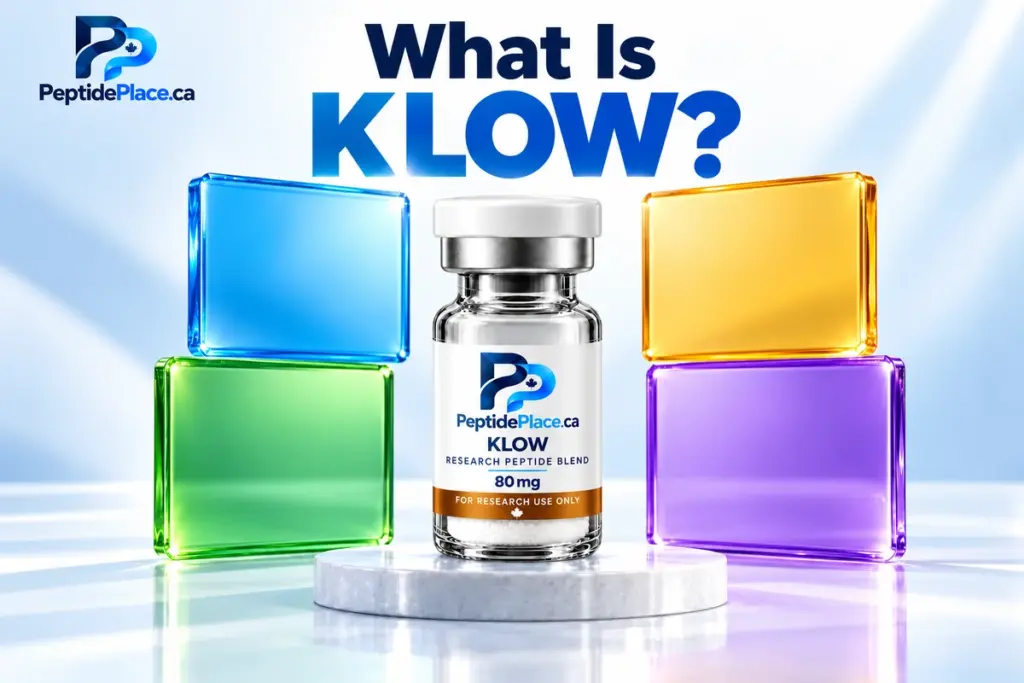
KLOW is a named peptide blend containing GHK-Cu, BPC-157, TB-500 and KPV in this catalogue. A blend is a formulation containing more than one named ingredient. Understanding it starts with composition, followed by the quantity and documentation for each component.
What does the blend name tell you?
The name identifies a catalogue formulation, rather than one universal molecular sequence. It should be read alongside an ingredient specification. Different suppliers can use informal blend names differently, so a shared name alone does not establish identical composition or ingredient amounts.
For KLOW, the ingredient list is the starting point. The total package amount describes the combined nominal material quantity. Individual component amounts must be confirmed from the actual specification. This profile does not assume equal proportions or create a component breakdown that has not been documented.
| Question | Why it matters | What to compare |
|---|---|---|
| Which ingredients? | Defines what is being discussed | Each named material |
| How much of each? | A total does not identify the split | Confirmed component amounts |
| Which identity? | Informal names can conceal differences | Sequence/material details when supplied |
| Which evidence? | A mixture differs from a single ingredient | Studies of the actual formulation |
| Which sample? | Analytical findings concern a tested sample | Matching lot and source certificate |
Ingredient research and blend research are different
The ingredients in KLOW are discussed in tissue-repair, copper-peptide and inflammatory-signalling research. Their separate research histories can explain why a blend attracts interest. They do not, by themselves, establish that the mixture produces the same outcomes, that its ingredients reinforce each other, or that any particular ratio is optimal.
To assess a mixture directly, look for a study that identifies the actual composition and tests that formulation under specified conditions. If a source instead tests a single ingredient, describe it as ingredient evidence. Avoid using words such as “synergy” as a substitute for an experiment.
For the TB-500-labelled component, also check material identity before attributing findings from full-length thymosin beta-4 research. An informal name does not remove the need to establish which peptide a paper actually tested.
How KLOW compares with Wolverine
KLOW includes GHK-Cu and KPV in addition to the BPC-157 and TB-500 names shared with Wolverine. The comparison therefore begins with the added ingredients and their quantities, rather than the larger total amount.
A meaningful price comparison keeps composition visible. Price per total milligram can describe the listed mixture price, but it does not reveal the cost or quantity of each ingredient. More ingredients do not automatically establish a better research fit. Read the relevant comparison before opening the current catalogue options.
From a research question to a documented listing
Write down which ingredient or combination the research question concerns. Then check the actual specification: ingredient names, component quantities if available, total package amount and material identity. Record missing information as missing rather than inferring it from the product name.
Next, match an available report to the supplied lot. A purity result for a starting ingredient is not automatically a composition assay for a finished mixture. A source certificate needs to be interpreted according to its method and sample. The COA guide explains the document fields to check.
Questions readers ask
Is KLOW one peptide sequence?
No. In this catalogue, KLOW is a blend of named ingredients.
Can I divide the total equally between ingredients?
Only if an actual specification confirms that split. No equal ratio is assumed here.
Do ingredient studies prove the blend works better?
No. A claim about the combined formulation needs evidence for that formulation and outcome.
Composition sources and useful next pages
The ingredient list above describes the current Peptide Place catalogue formulation, not a published clinical finding. The KLOW product page owns current product facts and available documents. Peptide Blends Explained covers blend terminology.
For examples of ingredient-level primary research, see the BPC-157 tendon-mechanism study and the experimental KPV study. These references are not presented as studies of KLOW.
Follow the finished formulation
A KLOW total does not establish each ingredient amount. Read the blend-comparison guide and finished-formulation storage questions before borrowing findings or handling conditions from separate ingredients.
Explore this topic further
Reading the evidence
Four ingredients need four quantity checks
KLOW adds KPV to the GHK-Cu, BPC-157 and TB-500 ingredient set. Compare that composition with GLOW and Wolverine before comparing package amounts. A total blend quantity does not identify each component’s share or establish a combined research result.