 Canadian fulfilment · Free shipping $199+


Longevity peptides are peptides studied in processes connected with ageing, such as cell stress, metabolism and tissue maintenance. The phrase describes a research interest. It does not mean that a compound has been shown to help people live longer.
That distinction is useful when you come across MOTS-c, mitochondrial peptides or a headline about clearing ageing cells. A study can uncover an interesting process without showing that a treatment extends life. The best place to start is with the question the researchers actually tested.
This guide explains healthspan, lifespan and the kinds of peptide longevity research behind those terms. For the broader introduction, read biohacking and peptides overview. If the chemistry is new to you, our What Are Peptides? guide explains how short chains of amino acids become peptides.
What does longevity science study?
Ageing involves changes across many systems. Cells can become less able to handle stress. Tissues can change how they repair themselves. Metabolism, the set of processes that uses and stores energy, can also change. Longevity science asks how these processes relate to later-life health and survival.
There is no single “ageing switch” that explains every outcome. A change in one pathway may help a particular function while leaving other functions unchanged. It may also introduce a risk that a short experiment does not detect.
Healthspan and lifespan ask different questions
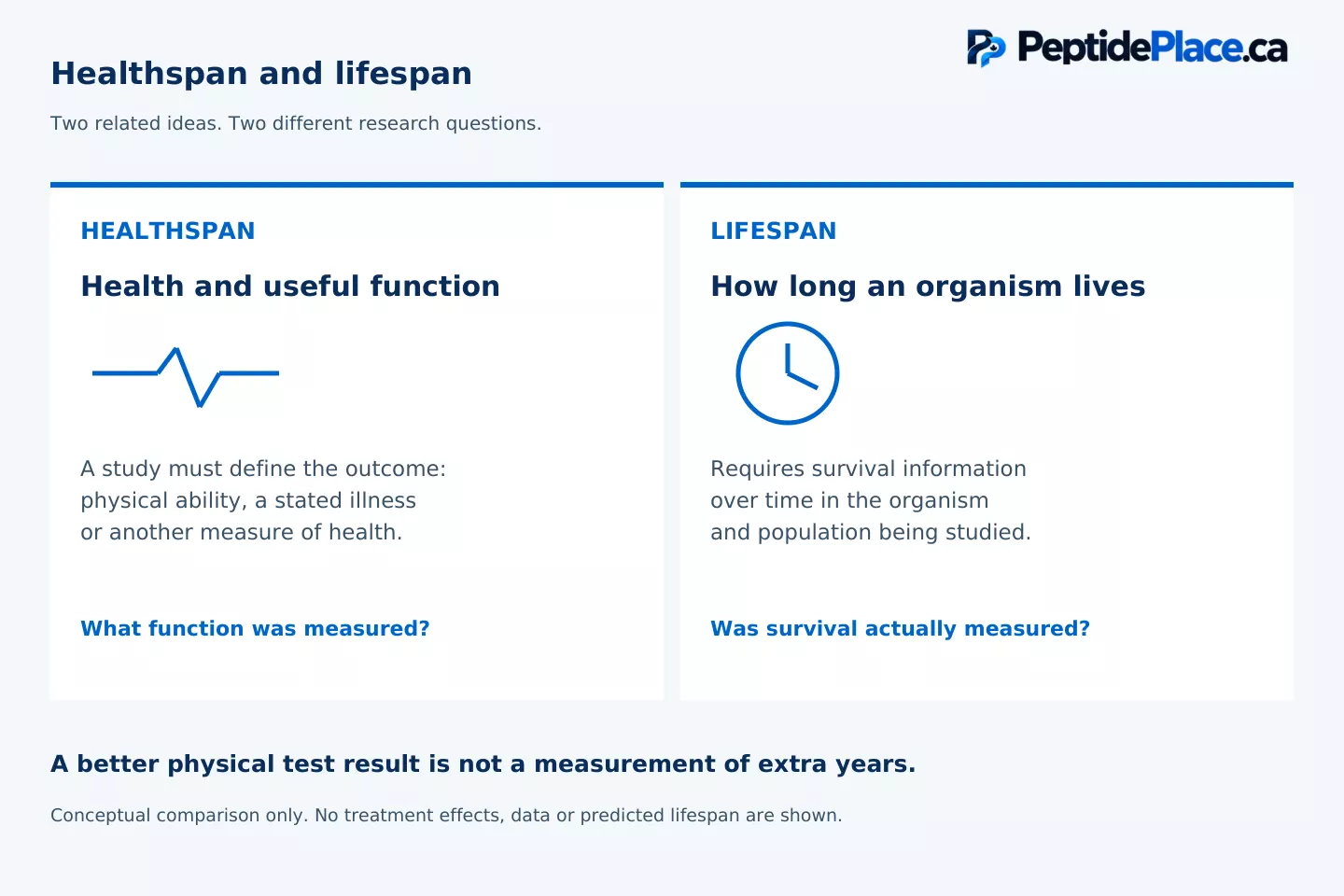
Lifespan is how long an organism lives. To test it directly, researchers need survival data over time. A change in a blood marker is not a measurement of lifespan.
Healthspan concerns the period of life spent in good health or with useful function. Studies need to define what that means: physical ability, freedom from a particular disease, or another stated measure. Different definitions can produce different findings.
A mouse that performs better on a treadmill has shown a change in a physical test. That result may matter to healthspan research. It does not tell us how many extra years a person could live.
Why peptides appear in ageing research
Peptides can carry signals or interact with proteins involved in cell behaviour. Researchers can use them to investigate how a pathway works. Some peptides come from signals already found in the body; others are designed in a laboratory for a specific experimental purpose.
The sequence matters. Changing the order of amino acids, adding a chemical group or changing a formulation can change what is being tested. Calling two materials “longevity peptides” does not make their evidence interchangeable.
A pathway is a starting point
A pathway is a connected set of biological steps. For example, a cell may detect a shortage of usable energy and adjust which activities it carries out. A peptide linked with that response can help researchers investigate the process.
Showing that a pathway responds is different from showing a lasting benefit. Researchers still need to ask how large the effect is, how long it lasts, what happens elsewhere in the body and whether the finding can be repeated.
MOTS-c: metabolic signalling and ageing
MOTS-c is a short mitochondrial-derived peptide. Mitochondria are structures inside cells that help convert nutrients into usable energy and take part in cell signalling. The MOTS-c research profile gives the compound-specific background; Mitochondrial Peptides Explained explains the broader family.
In a foundational 2015 paper, Lee and colleagues investigated MOTS-c in cell experiments and mice, including metabolic responses. That work helped establish a reason to study the peptide. It did not establish a human longevity treatment. Read Lee et al. (2015).
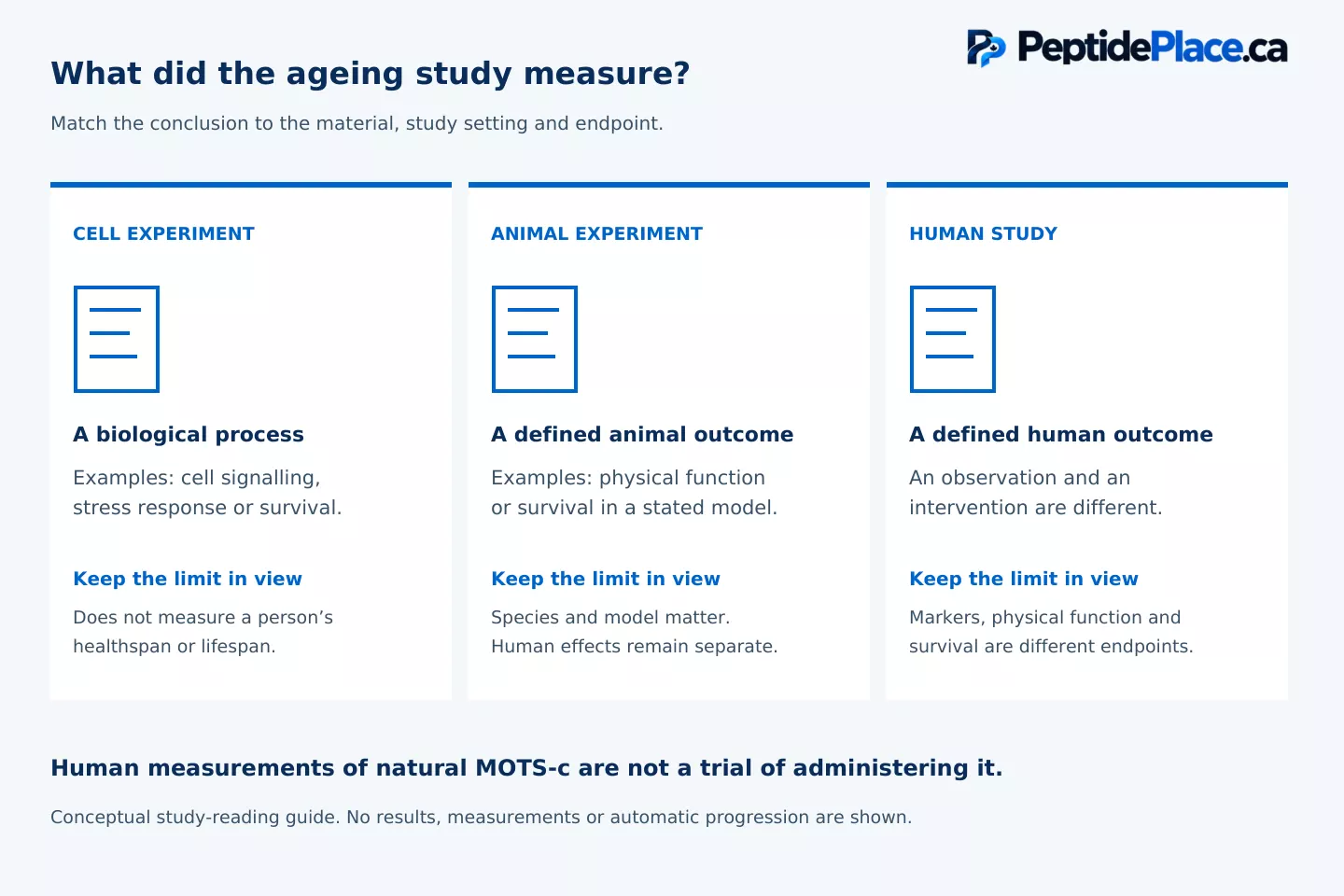
A 2021 study by Reynolds and colleagues examined physical performance and age-related function in mice. It also measured naturally occurring MOTS-c responses to exercise in humans. Those are separate parts of the work: observing a human exercise response is not a trial of giving people MOTS-c. Read Reynolds et al. (2021).
What would stronger human evidence need?
A human intervention study would need a clearly identified material, an appropriate comparison group, defined outcomes and a way to record unwanted effects. It would also need enough follow-up for the question being asked. A short study of a metabolic marker could not answer a decades-long survival question.
Natural presence in the body is also not a shortcut to a safety conclusion. Timing, amount, exposure and the people studied can all differ between normal biology and an experimental intervention.
Cellular senescence explained simply
A senescent cell has entered a state in which it no longer divides normally. It can remain alive and active. This is different from a dead cell. Senescence can serve useful roles, including responses to damage, but its effects depend on the tissue and circumstances.
Researchers study whether changing particular senescent-cell processes could alter age-related problems. Some experimental approaches aim to remove selected senescent cells. Others examine the signals those cells release. These approaches should not be treated as one interchangeable treatment.
For example, Baar and colleagues studied a designed peptide that disrupted a specific protein interaction involving FOXO4 and p53, with experiments in cells and mice. That is an example of targeted research into senescence, not evidence that unrelated peptides remove ageing cells or extend human life. Read Baar et al. (2017).
“Anti-ageing” is too broad to be an endpoint
A useful endpoint is something the study can measure. Cell survival, walking performance and time to a defined illness are different endpoints. “Anti-ageing” can blur them together. When you see that label, ask which outcome the original study measured and whether the headline describes it fairly.
Cell, animal and human evidence
Each setting helps answer a different question. Cells allow close examination of a process under controlled conditions. Animals allow researchers to study interactions within a living organism. Human studies examine defined outcomes in selected people. None automatically answers every question left by the others.
Why animal results may not carry over
Species differ in biology and lifespan. A study may use animals of one sex, age or genetic background. Diet, housing and the way an experimental condition is created can also affect results. These details help explain what the study tests; they are not minor footnotes.
Even a well-run animal study leaves human questions open. The relevant comparison is not simply “did it work?” It is “what changed, in which model, compared with what, and at what cost?”
Why human studies also need context
A clinical trial in people with a defined illness does not automatically describe healthy adults. An observational study can show that two things occur together without proving that one caused the other. A trial can also be too small or too short to detect uncommon or delayed problems.
Our How to Read Peptide Research guide explains comparison groups, endpoints and the difference between association and cause.
How to read a longevity-peptide claim
- Identify the material. Check the exact peptide, sequence or modification and formulation.
- Identify the model. Was it isolated cells, an animal experiment, a human observation or an intervention trial?
- Name the endpoint. Was the result a molecular marker, a physical test, illness or survival?
- Check the comparison. Look for a control group and ask what else differed.
- Look for follow-up and harms. A short-term favourable result may leave long-term questions unanswered.
- Separate the paper from the product. A catalogue description does not demonstrate that a particular batch matches a study material.
For the last step, How to Read a Peptide COA explains what a certificate of analysis can establish. Identity and purity testing answer material questions. They do not establish clinical effectiveness or prove a longevity claim.
What remains unknown?
Important open questions include which findings reproduce, which populations might be relevant, what happens with long exposure and whether changes in selected markers predict meaningful outcomes. Interactions among biological pathways can make a simple headline unreliable.
There is also a difference between preserving a function, treating a particular illness and extending lifespan. Evidence for one should not silently become a claim for the others. That is why this guide treats “longevity peptides” as a research category rather than a list of proven ways to live longer.
A note for Canadian readers
Clinical-trial authorization and permission to market a drug are different decisions. A study listing or a research-use label does not establish that a product is authorized for general use. Health Canada explains the distinction in its peptide research and clinical-trial guidance.
Frequently asked questions
Do longevity peptides extend human lifespan?
The cell and animal studies discussed here do not establish longer human lifespan. That conclusion would require suitable human survival evidence, not just a change in a marker or an animal performance test.
Is MOTS-c the same thing as NAD+?
No. MOTS-c is a peptide, a chain of amino acids. NAD+ is a coenzyme involved in cellular reactions and is not a peptide. Sharing a place in metabolism discussions does not make them the same kind of molecule.
Does a naturally occurring peptide have proven safety?
No. The way a molecule normally occurs in the body does not establish the safety of giving it as an intervention. The material, exposure, population and follow-up still need to be studied.
Can better skin or body-weight results prove a longevity benefit?
No. Skin appearance and body weight are different outcomes from survival or broadly defined healthspan. Each claim needs evidence for its own endpoint.
Keep exploring peptide science
Start with the exact molecule and the original study, then keep the conclusion within what was measured. The linked MOTS-c profile, mitochondrial primer and research-reading guide provide the next level of detail without turning an early finding into a promise.
Check the evidence behind a longevity headline
For a second look at a longevity claim, compare its study design and outcome and use the glossary of research terms. A batch certificate remains a separate record of material testing, rather than evidence of a lifespan effect.