 Canadian fulfilment · Free shipping $199+

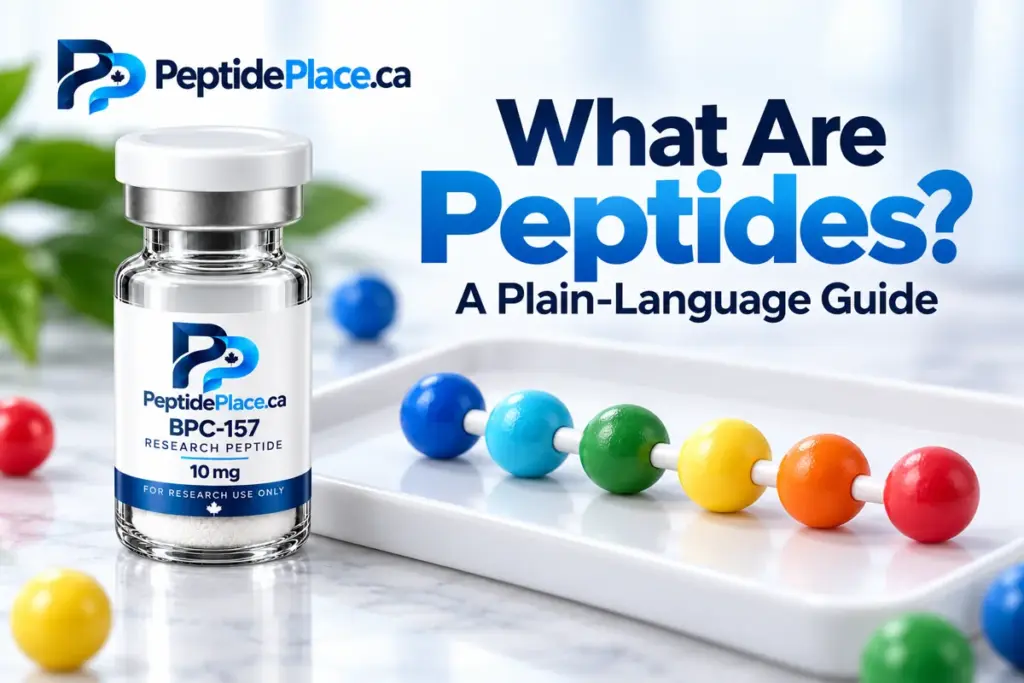
Peptides are short chains of amino acids, the building blocks also used to make proteins. Different chains have different roles. Start with what a compound is, why it attracts interest and what the research actually measures.
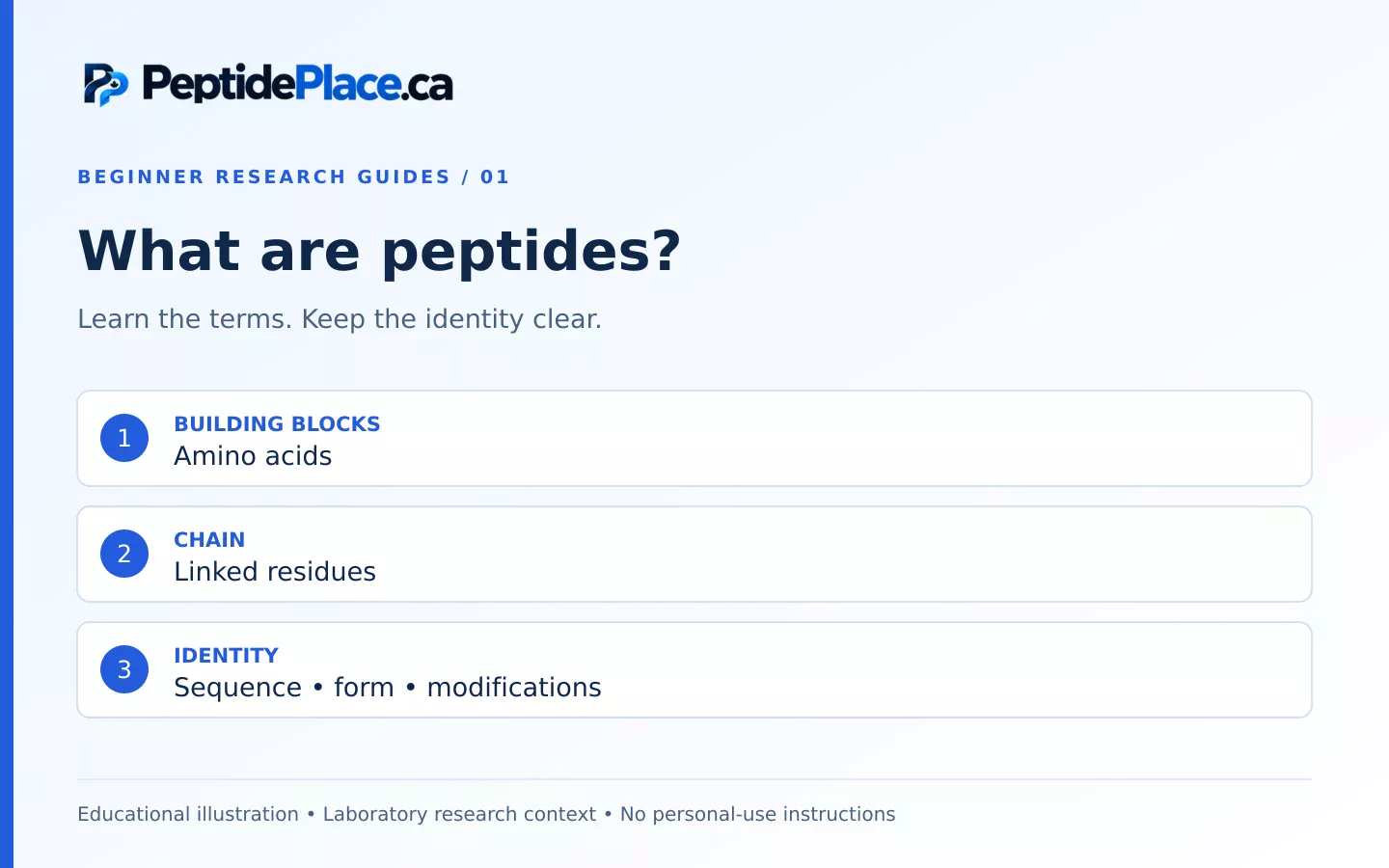
A peptide is a molecule built from linked amino-acid residues. The term describes chemistry; it does not tell you the biological effect, evidence quality or suitability of a particular product.
Peptides, amino acids and sequence
Amino acids are the building blocks used to describe peptide chains. Their order is called the sequence. That order matters: a list of ingredients without the order is not the same description as a defined molecule. The name of a compound can be familiar while the full structural specification remains unclear.
Length is one useful descriptor. A tripeptide contains three amino-acid residues; a pentadecapeptide contains fifteen. Those terms help organise chemistry, but they do not rank potency, quality or usefulness. A longer chain is not automatically more effective, and a shorter chain is not automatically easier to interpret.
For a first comparison, write down the compound name, the sequence if confirmed, and any modification stated with it. Keep a question mark beside missing information rather than completing the description from a different supplier’s page.
Why chemical form and formulation matter
The sequence alone may not describe the whole supplied material. Terminal modifications, an associated salt, copper complexation or other structural features can change the specification. A database entry can describe a reference form without confirming the contents of the vial you are reviewing.
Formulation is another layer. A research preparation, a topical cosmetic and a regulated medicine can share a compound name while differing in composition, manufacture and intended use. Treat the actual formulation as part of the identity, not as a detail that can be ignored after recognising the name.
| Description | What it helps identify | What it does not prove |
|---|---|---|
| Compound name | The intended molecule or research family | The identity of supplied stock |
| Sequence and modifications | The specified structure | A measured batch result |
| Physical form | How the material is supplied | Universal storage stability |
| Batch certificate | Tests on an identified submitted sample | Every possible quality or biological endpoint |
Examples from the Peptide Place catalogue
The catalogue illustrates why one umbrella term needs several questions. BPC-157 and KPV differ in their peptide descriptions and research settings. GHK-Cu introduces copper-complex specification questions. MOTS-c is discussed in a mitochondrial-derived peptide context. These distinctions are starting points for reading, not recommendations for a personal outcome.
The same care applies to trade names. KLOW and Wolverine identify blends in this catalogue. They are not single sequences, and their total nominal amounts do not supply the individual ingredient quantities. A useful comparison must keep each component and its documented amount visible.
Choose the product page when you need sizes, prices and supplied-material details. Choose the research profile when you want a reading path through the literature. Neither page should be asked to establish something it does not document.
From a mechanism to an actual finding
Scientific descriptions often begin with a receptor, signalling pathway or cell process. That can explain why a compound is studied. It is not the same as demonstrating a meaningful outcome in every setting in which the compound is mentioned.
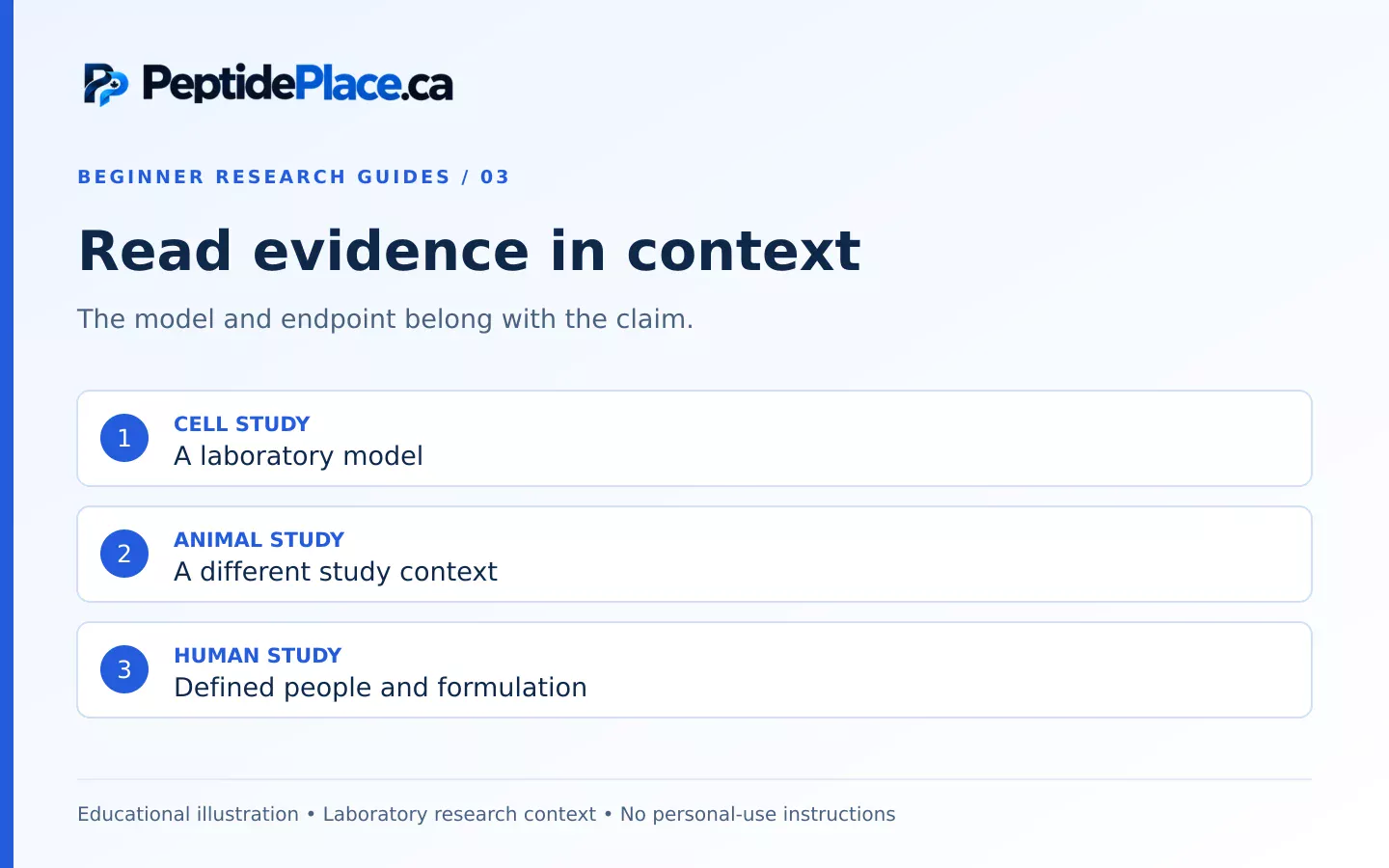
Read the model and endpoint together. Cell migration is a different endpoint from tissue mechanics; a metabolic biomarker is different from a body-weight result. A controlled human study also belongs to its participants, formulation and duration. A website summary should preserve those boundaries.
A useful evidence note has three sentences: what the researchers asked, what they measured, and what remains unanswered. If a summary omits one of these, open the original source before relying on the headline.
Read a product listing in five passes
- Identity: compound name, exact structure where confirmed, and supplied form.
- Option: the selected size, nominal content basis and SKU.
- Availability: the actual stock status and current CAD price.
- Documentation: the lot code, source report and endpoints measured.
- Context: references, model limitations and questions still requiring confirmation.
Do these passes in order. It is easy to focus on a price or a large percentage before noticing that the size, identity or batch is different. Keeping the questions separate makes it easier to compare two listings fairly and to send a precise support enquiry.
If you are browsing for the first time, begin with one product rather than opening the entire catalogue at once. Complete the five passes, note missing details, and use the same process for the next material.
A beginner’s learning path
Start with the peptide glossary for unfamiliar terms. Continue to research peptide specifications to understand the fields, then read a COA to separate a listing from a measured result.
How PP’s research areas help you browse
| Current research area | A starting example | What to check next |
|---|---|---|
| Repair & Recovery | BPC-157 or TB-500 | Exact identity and the model studied |
| Skin & Hair | GHK-Cu | Formulation and the actual skin or hair endpoint |
| Weight & Metabolism | Retatrutide or MOTS-c | Distinct mechanisms and study contexts |
| Growth Hormone | CJC-1295 No DAC or Ipamorelin | The stated compound, not an assumed hormone product |
| Gut & Inflammation | KPV | Which inflammatory model is being discussed |
| Peptide Blends | GLOW, KLOW or Wolverine | Every ingredient and its documented amount |
These are browsing areas from the current site, not promises of a personal outcome. Open the Research Library when you want the source context and comparisons when you want to understand a specific pair.
Single compounds, blends and bundles
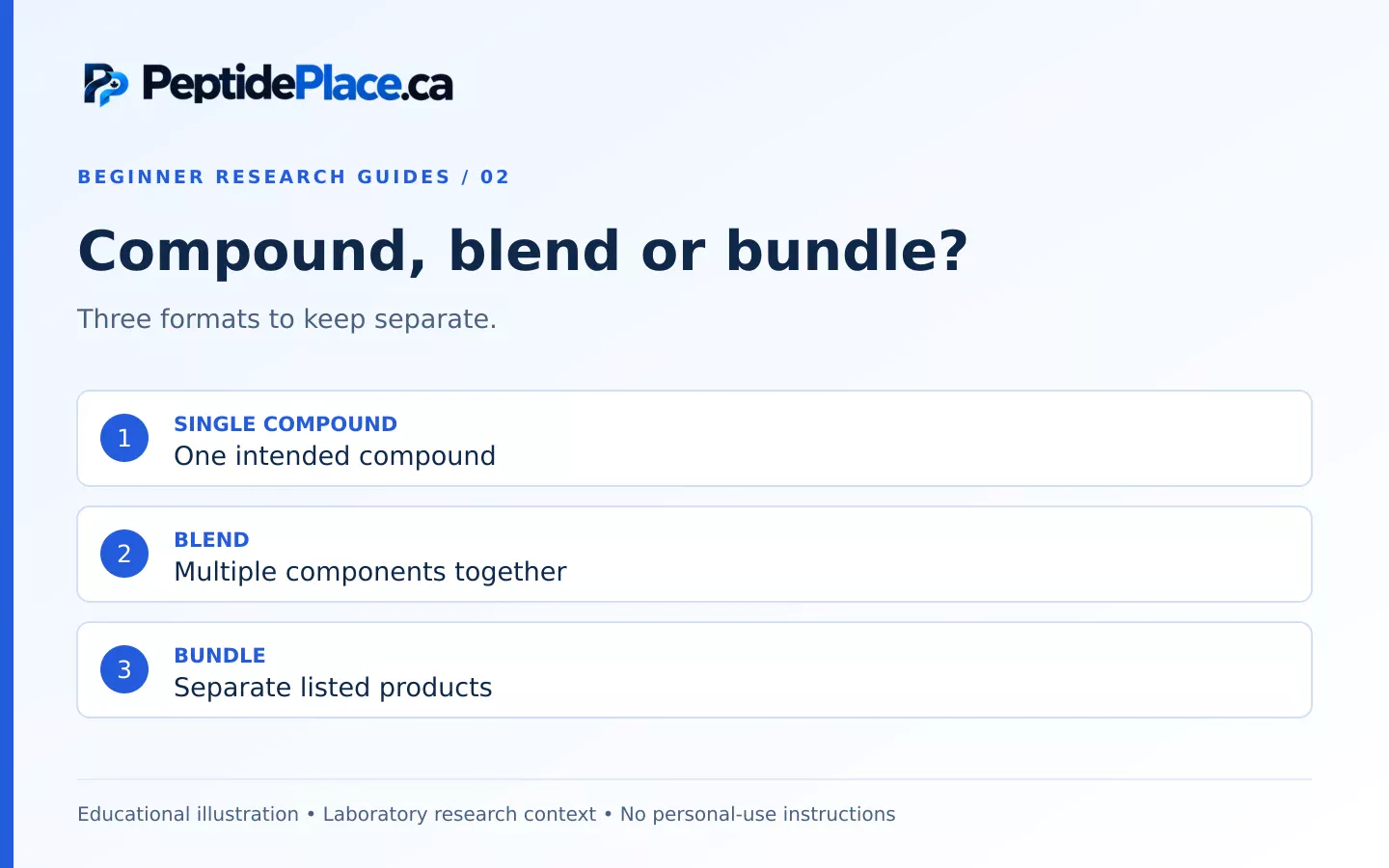
A single-compound listing identifies one intended compound. A blend contains multiple listed components in one preparation. A bundle may contain separate products. Keep those formats distinct when comparing contents or prices.
A blend’s total nominal amount does not tell you each ingredient’s amount. Study findings for individual components do not automatically demonstrate the same findings for the finished mixture. Read peptide blends explained for the dedicated overview.
How do peptides connect with biohacking and longevity?
You may have heard about peptides through biohacking, longevity, fitness or recovery research. These words often come up together, but they mean different things.
Biohacking is a broad term for trying to understand or influence how the body works. Longevity research focuses on ageing and long-term health. Peptides are molecules studied across many areas of biology, including metabolism, tissue responses, skin biology and hormone signalling.
Some peptide-based medicines have established uses. Other compounds remain experimental.
Curious about the connection? Read Biohacking and Peptides: What Does the Science Say? for familiar compound names, research topics and what the evidence can tell us.
Frequently asked questions
Are all peptides medicines?
No. Peptide describes a chemical class. The product’s formulation, intended purpose and applicable authorisation are separate matters.
Is a larger mg size a stronger effect?
The listed amount is package information. It does not establish a biological effect or an administration instruction.
Where should I go after the basics?
Read specifications and COA guides, then choose a research profile that matches your actual question.
Sources and further reading
Technical sources support the analytical concepts; scientific findings belong to their stated study models. Examples and review worksheets in this guide are educational tools, not Peptide Place batch results.
Editorial and corrections policy · Report a factual or documentation issue
Put the explanation into practice
Choose one compound and check its name, current sizes and research summary. Then compare a related compound before opening a source report. BPC-157 and TB-500 provide a useful recovery comparison; GHK-Cu introduces the skin and collagen conversation. For different metabolic pathways, compare Retatrutide and MOTS-c.
Open the comparison tool or return to the beginner learning path.
Additional technical sources
Peptide receptors and signalling, explained simply
A receptor is a protein that can recognise a signal and help a cell respond. Think of a receiver tuned to particular messages. The comparison is useful, but cells are more complicated than a simple on/off switch: the receptor, cell type, concentration and measurement all affect the response.
An agonist activates a receptor in the system tested. That does not tell you the size of every downstream effect. A compound can act at more than one receptor, and two compounds associated with the same research interest can use different pathways.
For example, tirzepatide is studied at GIP and GLP-1 receptors. Retatrutide is studied at those receptors and the glucagon receptor. Their original development papers describe defined experiments, not a general ranking of all peptides. Read the GLP-1, GIP and glucagon receptor guide for that specific signalling family and the compound comparison for study context.
MOTS-c belongs in a different research discussion, involving mitochondrial biology and cellular metabolic regulation. A shared word such as “metabolism” does not make MOTS-c an incretin analogue. Nor should a proposed pathway in BPC-157 research be presented as though one universal, clinically established BPC-157 receptor explains every result.
Sources: tirzepatide discovery and receptor experiments; retatrutide discovery and clinical proof-of-concept paper; original MOTS-c research. Use the study-reading guide to separate a biological explanation from a demonstrated clinical outcome.