 Canadian fulfilment · Free shipping $199+


Biohacking and peptides often come up in the same conversation. You may recognise names such as BPC-157, GHK-Cu, MOTS-c and Retatrutide from discussions about recovery, longevity, metabolism or performance.
But what is biohacking? Why are peptides part of the conversation? And what does the research actually tell us? Let’s start with the peptides.
What are peptides?
Peptides are short chains of amino acids, the same building blocks used to make proteins. Some occur naturally in the body and help cells communicate. Others are made in laboratories for scientific research or medical use.
Different peptides can have very different structures and roles. A compound involved in hormone signalling is not automatically related to one studied in skin biology. That’s why understanding the exact peptide matters more than recognizing a popular category name. New to the topic? Read our plain-language guide to peptides.
Why are peptides connected to biohacking?
Biohacking describes attempts to measure, understand or influence biology. For some people, it means tracking sleep or exercise. For others, it includes following research into metabolism, ageing, hormones or experimental compounds.
Peptides appear in these conversations because scientists study them across many biological systems. But biohacking is not a medical classification. A peptide being popular online does not establish that it is safe or effective for a particular use.
Six peptide names you’ll hear in these conversations
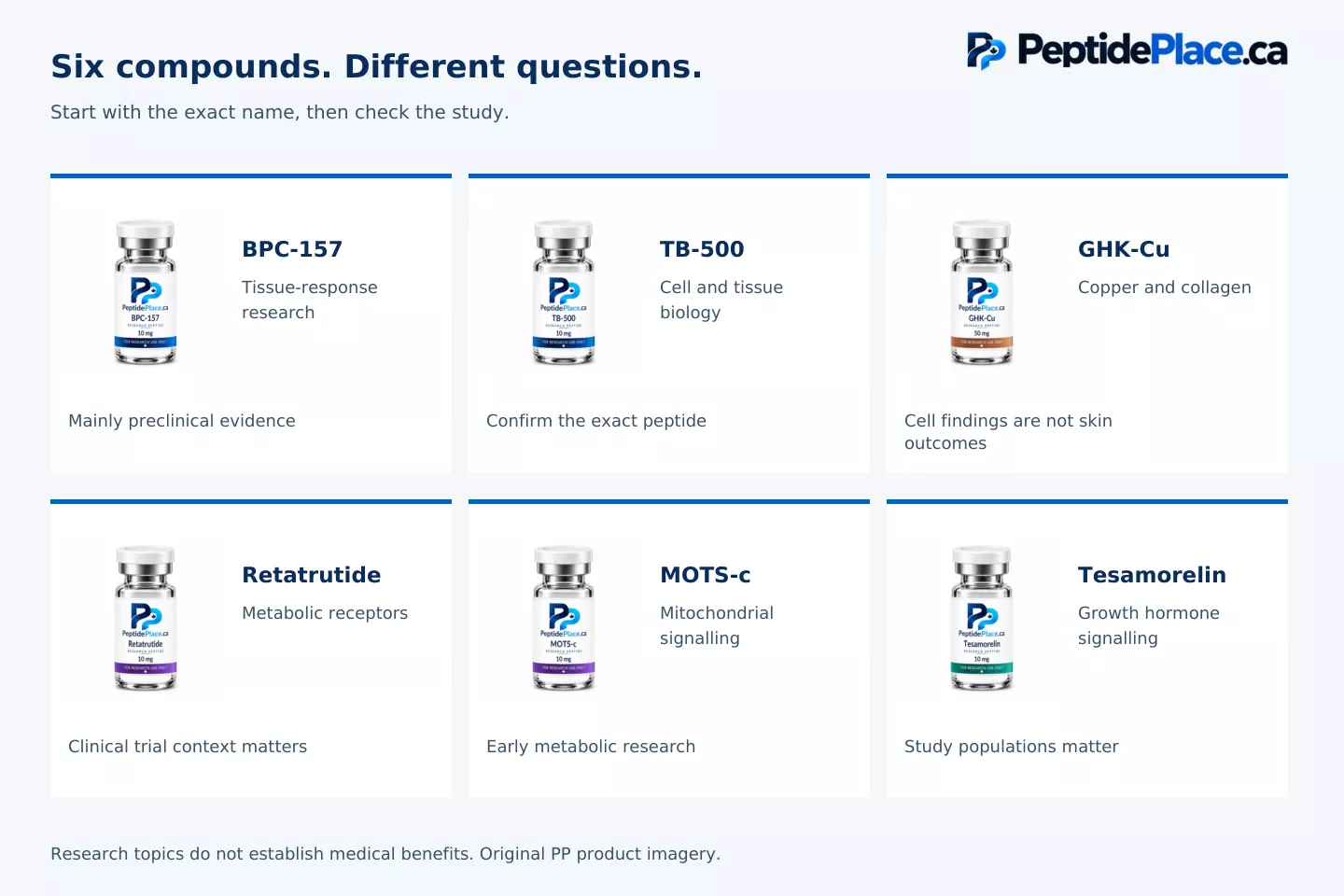
BPC-157: Tissue-response research
BPC-157 frequently appears in discussions of tissue repair and recovery. Researchers have studied biological activity in experimental models, including tissue responses associated with healing. Much of the available work is preclinical; laboratory and animal findings cannot establish a treatment benefit in people. One 2003 study examined a cut Achilles tendon in rats and tendon-cell growth in culture. Those are specific experimental models, not a trial of injury recovery in people. Our BPC-157 tendon research guide walks through that distinction.
TB-500: Cell movement and tissue biology
TB-500 is frequently mentioned alongside BPC-157 and thymosin beta-4. The identity of material marketed under the name TB-500 should be checked carefully. Research involving full-length thymosin beta-4 is not automatically evidence for every compound marketed using a similar name. A 1999 thymosin beta-4 study examined wound repair in rats and cell movement in a laboratory assay. Check the sequence and test material before applying that paper to a TB-500 listing. The BPC-157 vs TB-500 comparison helps separate the names.
GHK-Cu: Copper peptides and skin research
GHK-Cu is a copper-binding peptide investigated in skin and cellular biology. It appears in discussions about collagen and cosmetic peptides. Formulation matters: a study of a topical cosmetic preparation does not establish the safety or effects of a different preparation. In a 1988 fibroblast experiment, researchers measured collagen synthesis in cultured cells. That is a useful starting point for understanding a mechanism, rather than a promise about visible skin changes. Read our GHK-Cu and collagen research guide for that background.
Retatrutide: Metabolic receptor research
Retatrutide is an investigational peptide that acts on GLP-1, GIP and glucagon receptors. These receptors have different roles in metabolic signalling. Retatrutide is often compared with semaglutide and tirzepatide, but their receptor activity, evidence and regulatory status differ. A 2023 randomized phase 2 trial studied body-weight outcomes and adverse events in adults with obesity. It provides human evidence for that defined study setting. It does not test lifespan or establish that a separately supplied research vial is equivalent to the trial material. Start with GLP-1, GIP and glucagon receptors explained to understand the targets.
MOTS-c: Mitochondrial research
MOTS-c is a mitochondrial-derived peptide studied in cellular metabolism. Mitochondria are cell structures involved in producing usable energy. Researchers investigate MOTS-c to understand aspects of metabolic regulation and signalling. In the 2015 original study, scientists investigated metabolic activity in cells and mice, including insulin sensitivity in mouse models. That does not establish that a MOTS-c product boosts energy or performance in humans. See Mitochondrial Peptides Explained.
Tesamorelin: Hormone signalling
Tesamorelin is a synthetic analogue of growth hormone-releasing hormone, or GHRH. This hormone signals the pituitary gland to release growth hormone. A 2007 randomized trial, involving a team at McGill in Montreal, examined visceral fat in people with HIV and treatment-associated abdominal fat accumulation. That population and outcome matter. It was not a general anti-ageing trial, and its findings do not apply to every growth-hormone-related peptide. Our growth hormone secretagogue guide explains the wider terminology.
Are these peptides all part of the same family?
They can all be discussed in peptide research, but they are not interchangeable. Their amino acid sequences, structures, targets, clinical evidence and intended study questions may differ. GHK-Cu, for example, is associated with copper-binding and skin biology; Retatrutide acts at metabolic receptors. Grouping both under biohacking does not tell us how either works. The Weight & Metabolism guide provides more context for metabolic compounds, while Repair & Recovery covers tissue-response research.
What does the science actually show?
This is where many online explanations get confusing. A social post may describe an experiment as promising even though researchers tested the compound only in cells or animals. Those findings can be important, but they answer different questions from a clinical trial in people.
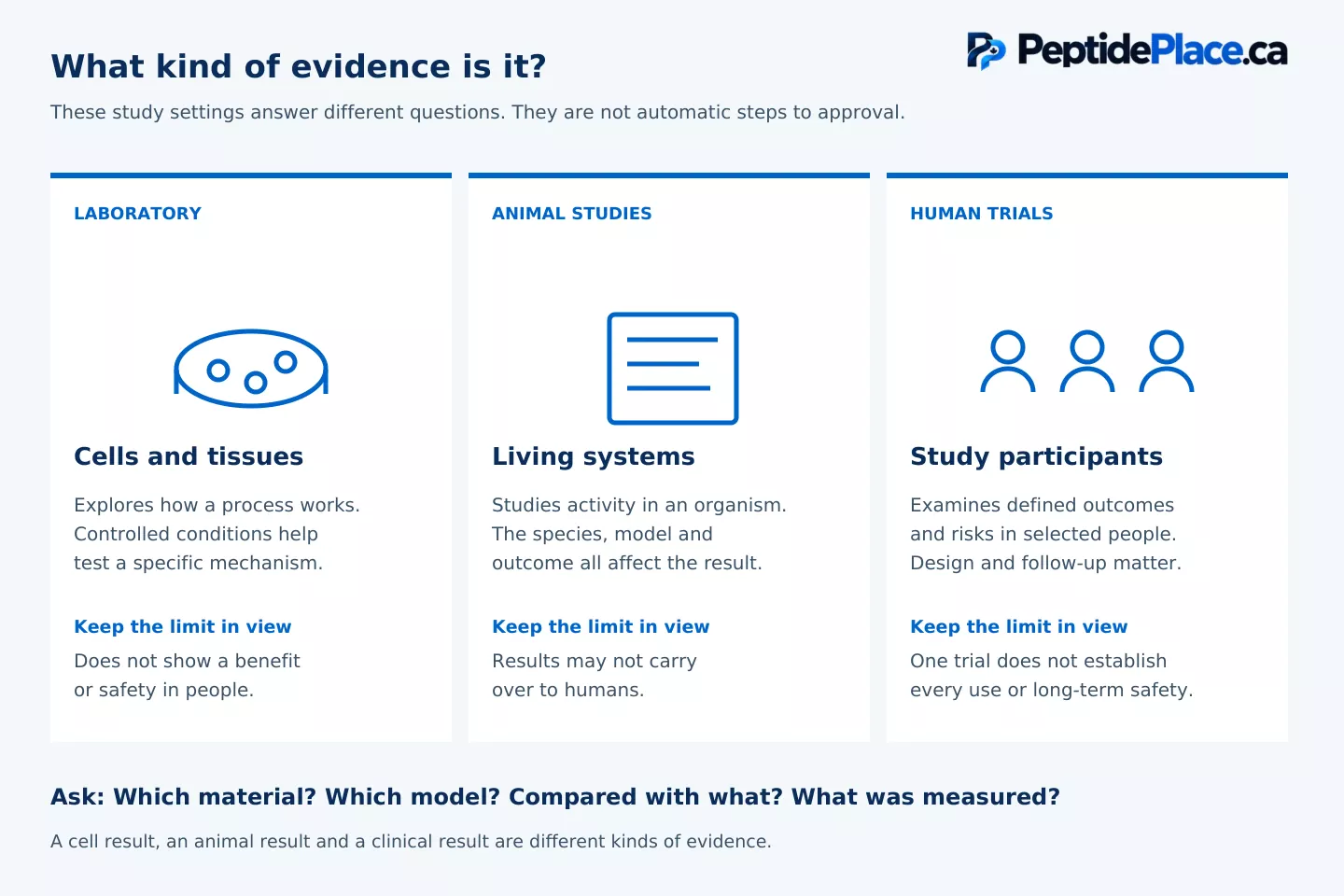
Laboratory studies
Scientists study cells, tissues or chemical systems under controlled conditions. These experiments help researchers explore possible mechanisms, but they cannot establish clinical safety or effectiveness.
Animal studies
Research in animals can provide information about activity in a living system. However, the same effects may not appear in humans.
Human clinical trials
Clinical studies can examine safety and measurable outcomes in groups of participants. Trial design, participant selection, comparison groups, size and follow-up all affect what can be concluded. A small early trial is not the same as multiple large, independently repeated studies.
For more detail, see How to Read Peptide Research.
How to check a peptide claim in five minutes
Start with the sentence you want to check. “This changes collagen production in cultured cells” is a different claim from “this makes skin look younger.” A clear question stops the research from drifting into a much larger promise.
- Find the original paper. Look for an author, journal, year and link. A screenshot of an abstract is harder to check than the complete record.
- Name the exact material. Was it the same peptide, a fragment, a modified form or a multi-ingredient preparation? Similar names can hide important differences.
- Identify the model. Cells, mice and people are not interchangeable. For human research, check who took part and who was left out.
- Read what was measured. A blood marker, cell signal or short-term weight change is not the same outcome as fewer illnesses or longer life.
- Look for what could change the conclusion. Small groups, short follow-up, missing comparison groups and unreported harms can limit confidence.
For example, the GHK-Cu culture study above can help explain why researchers became interested in collagen. It cannot, on its own, answer whether a different formulation changes wrinkles. That extra step needs its own evidence.
Keep a short note with the claim, source and missing answer. Our research-reading guide goes deeper into controls, study size and endpoints.
Where do longevity and regenerative medicine fit in?
Longevity science explores ageing, lifespan and healthspan, the years spent in relatively good health. Regenerative medicine examines ways to repair, replace or regenerate damaged cells or tissues. Certain peptide research questions overlap with these fields, including cellular signalling and tissue responses. Those scientific connections are not proof that a compound reverses ageing or treats an injury.
What about peptide stacks and blends?
A stack usually describes combining several substances in a proposed regimen. A blend refers to a preparation containing multiple ingredients. Neither term establishes safety or effectiveness. Studying compounds separately does not tell researchers everything about combining them. Ingredient identity, amount and potential interactions matter. Our peptide blends guide separates ingredient lists from evidence about a finished combination.
Does purity testing prove a peptide works?
No. Purity testing can describe aspects of the composition of a tested sample using a particular method. A certificate of analysis (COA) can report identity or measured content when the right tests were performed. A purity percentage alone does not establish either of those facts. None of these analytical results, on its own, establishes sterility, clinical safety, effectiveness or regulatory authorization. Read the guide to peptide COAs for more detail.
What should Canadian readers check?
A published study, permission to run a clinical trial and authorization to sell a medicine are separate things. Health Canada explains that a research-use label does not establish that a product is safe for human use or exempt it from Canadian requirements. Its peptide research and clinical-trials guidance is a useful first source.
This article explains research. It does not provide a personal-use protocol. Questions about a health condition or treatment belong with a licensed health care professional.
What should you take away?
Peptides are a major subject of modern biological research. Biohacking is one community bringing attention to that work, but the most useful way to learn is to start with the specific compound, find out what researchers measured, and understand what remains unknown.
Frequently asked questions
Are peptides and biohacking the same thing?
No. Peptides are molecules. Biohacking is a broad term for attempts to measure or influence biology.
Are all peptides experimental?
No. Some peptide-based medicines are established and authorized for specific uses. Others are still being investigated.
Are longevity peptides proven to slow ageing?
There is no general evidence that products described as longevity peptides reliably extend human lifespan. Claims need to be evaluated compound by compound.
Does an animal study prove that a peptide works in people?
No. Animal models can be useful, but clinical benefits and risks in people require appropriate human evidence.
Does research-grade mean approved or safe?
No. The term alone does not establish medical authorization or that a preparation is safe for human use.
Keep exploring peptide research
Start with What Are Peptides?, explore the peptide comparison tool, or browse the full Research Library for more research guides and testing information.
Sources and further reading
These are original studies and official guidance used for the examples above. They address different questions; they do not validate a Peptide Place product or batch.
- Staresinic and colleagues, 2003. BPC-157 in a rat Achilles-tendon model and tendon-cell experiments. Journal of Orthopaedic Research. DOI: 10.1016/S0736-0266(03)00110-4.
- Malinda and colleagues, 1999. Thymosin beta-4 in wound-healing and cell-migration experiments. Journal of Investigative Dermatology. DOI: 10.1046/j.1523-1747.1999.00708.x.
- Maquart and colleagues, 1988. GHK-Cu and collagen synthesis in fibroblast cultures. FEBS Letters. DOI: 10.1016/0014-5793(88)80509-X.
- Jastreboff and colleagues, 2023. Randomized phase 2 retatrutide trial in adults with obesity. New England Journal of Medicine. DOI: 10.1056/NEJMoa2301972.
- Lee and colleagues, 2015. MOTS-c and metabolic regulation in cell and mouse experiments. Cell Metabolism. DOI: 10.1016/j.cmet.2015.02.009.
- Falutz and colleagues, 2007. Tesamorelin and visceral fat in people with HIV. New England Journal of Medicine. DOI: 10.1056/NEJMoa072375.
- Health Canada. Peptides: Research and clinical trials. Official Canadian guidance, checked 8 November 2026.
Want to follow the longevity research more closely?
Our longevity peptides research guide explains healthspan versus lifespan, MOTS-c studies and cellular senescence. It separates changes in cells and animal function from evidence of longer human life.