 Canadian fulfilment · Free shipping $199+

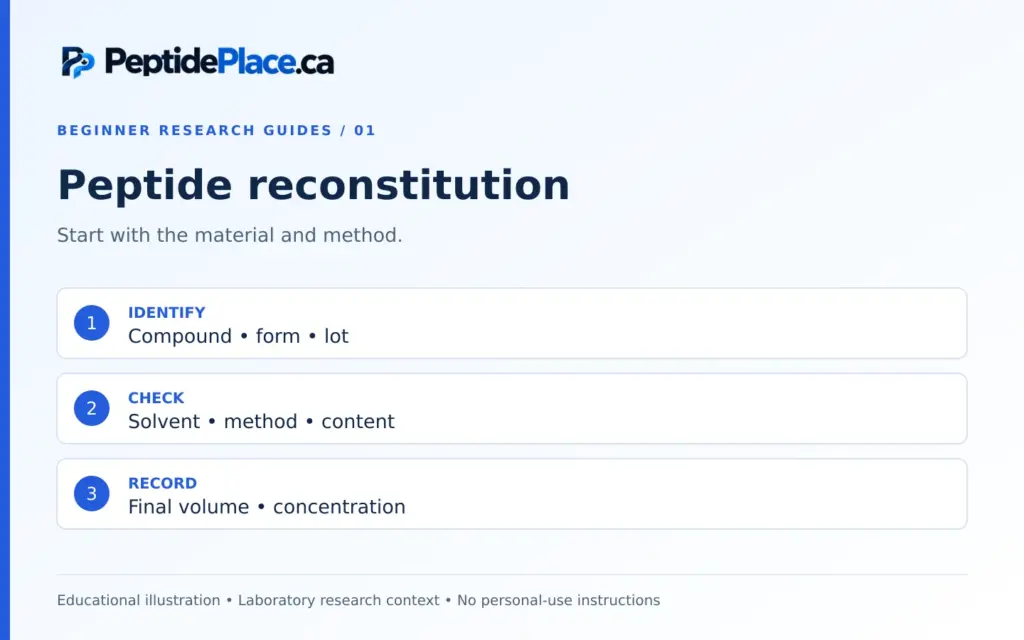
Peptide reconstitution means dissolving a dry peptide preparation in a suitable liquid for a defined laboratory method. The useful starting question is not “how much water goes in every vial?” It is “what does the exact material and research method require?”
What reconstitution changes
A freeze-dried preparation and a solution are different material states. Adding a liquid changes the concentration and introduces new handling and storage questions. It does not establish identity, sterility or suitability for a particular experiment. A clear-looking solution is an observation, not an analytical result.
Bachem’s technical guidance explains that peptide solubility varies with chemical properties and does not offer a universal dissolving protocol. That is why a generic recipe should not replace the specification for the material in front of you.
Before you prepare a solution: five checks
| Check | Record before proceeding |
|---|---|
| Identity | Exact compound, modifications or complex, supplied form and lot. |
| Method | The approved laboratory method and the person responsible for it. |
| Compatibility | Documented solvent, pH and concentration requirements. |
| Content basis | Whether the calculation uses nominal label amount, measured content or another specified basis. |
| Storage | The documented conditions for the prepared solution and any supported holding time. |
If a required field is missing, ask for it. A solvent used in another supplier’s example may not describe your formulation. Follow your institution’s safety procedures and the applicable safety data sheet.
Concentration is arithmetic; compatibility is chemistry
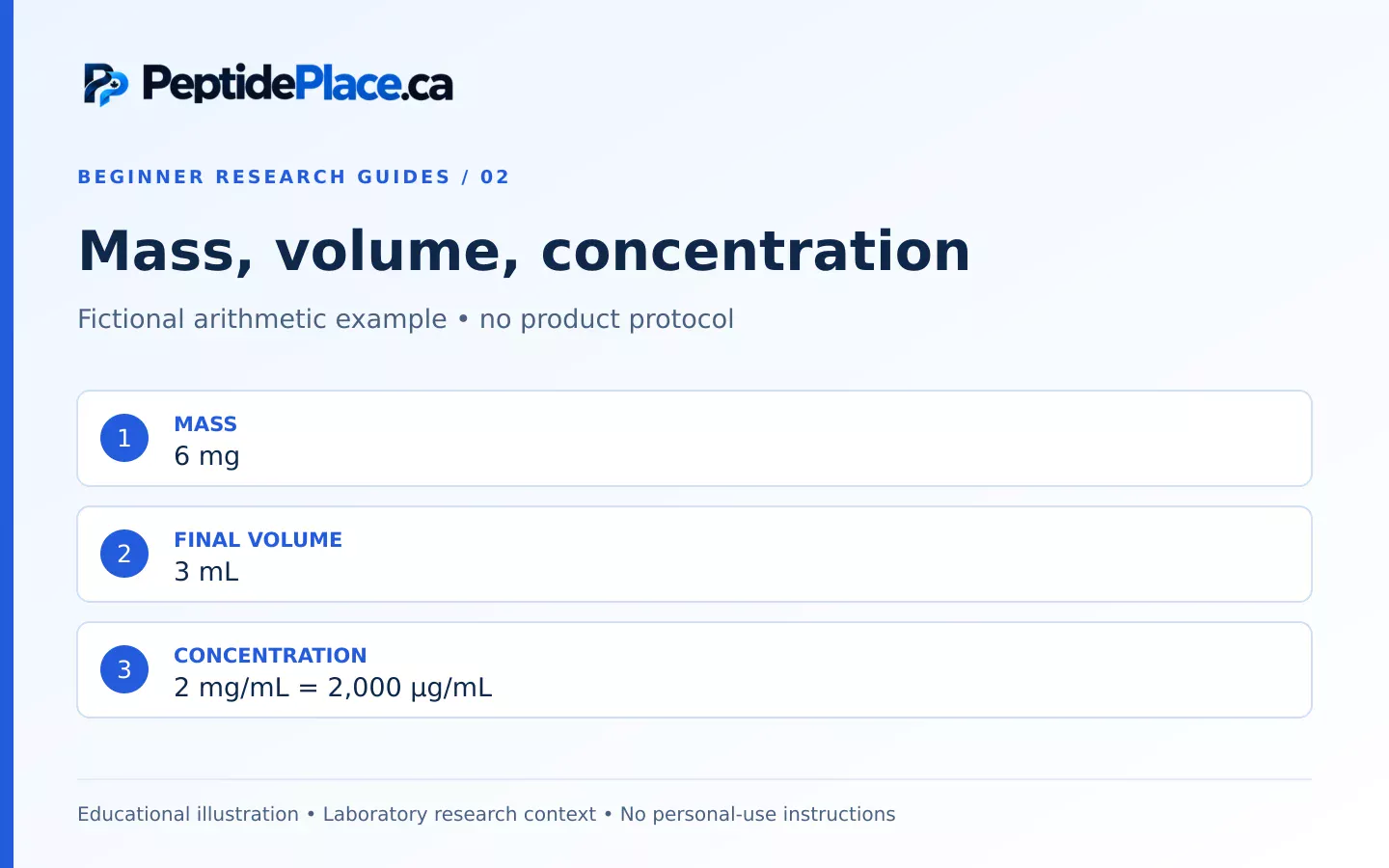
Concentration expresses how much material is present in a volume. For a simple mass-per-volume calculation, divide the mass by the final solution volume. Final volume is not always identical to the volume of liquid added; the method should state which is intended.
Fictional laboratory arithmetic example: a method specifies 6 mg of material in a final volume of 3 mL. The nominal concentration is 2 mg/mL, equivalent to 2,000 µg/mL. This example selects neither a solvent nor a preparation volume for any PP product. It is not a dosing instruction.
| Quantity | Meaning in this example |
|---|---|
| 6 mg | Mass used in the calculation |
| 3 mL | Final solution volume |
| 2 mg/mL | Nominal mass concentration |
| 2,000 µg/mL | The same concentration in different mass units |
Keep the units visible at every step. Purity percentage, net peptide content and nominal vial amount answer different questions; do not silently treat them as interchangeable. Read purity versus content before using a percentage to alter a calculation.
Build a useful preparation record
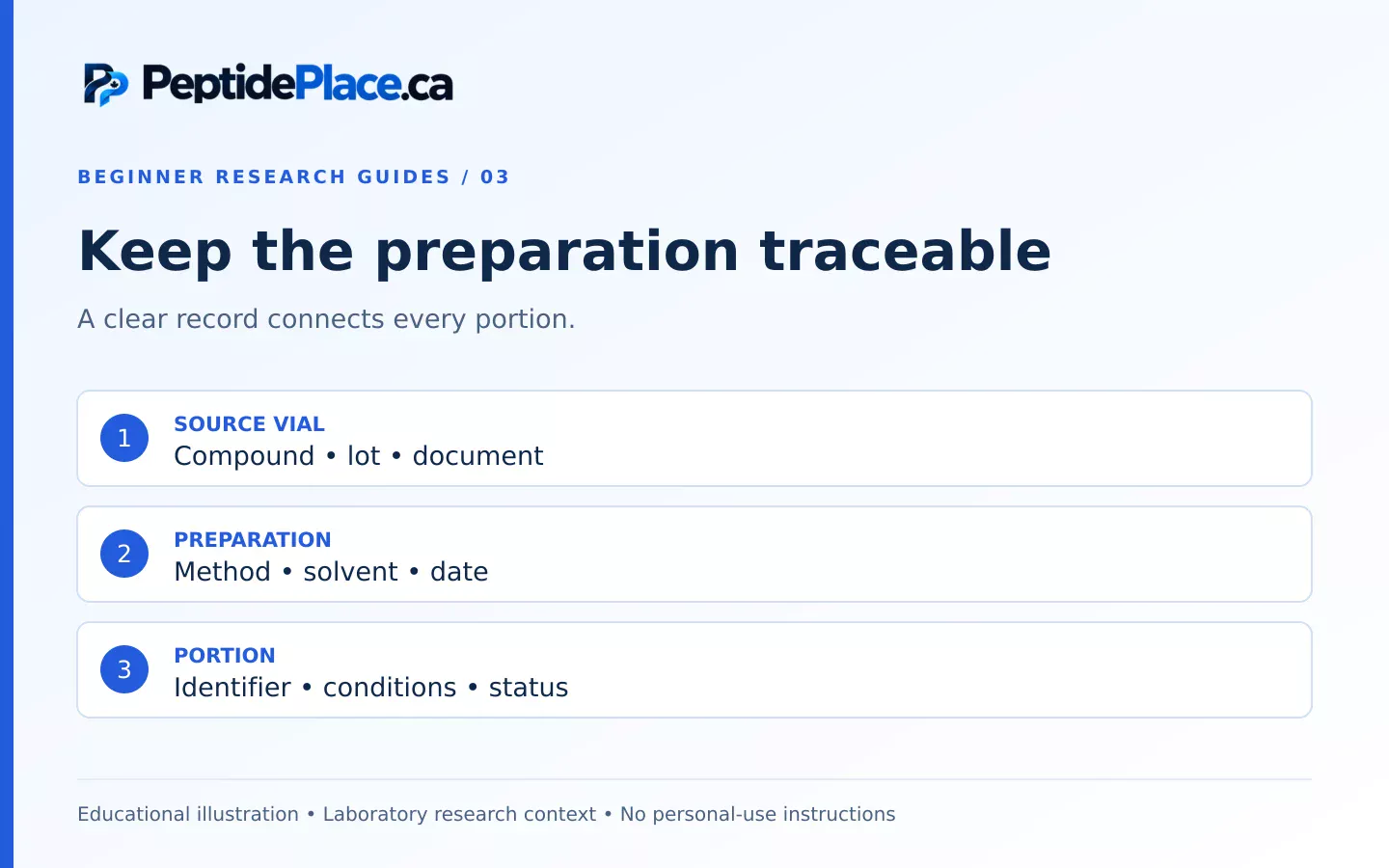
A short record should let another person reconstruct what was prepared. Record the source vial and lot, source document version, content basis, solvent identity and lot, final volume, calculated concentration, preparation date, operator, container identifier and storage instruction. If the method uses aliquots, retain the connection to the parent preparation.
Use a clear status field: planned, prepared, held for clarification, or released under the laboratory’s procedure. Do not make “looks dissolved” the sole release condition. A record with an unresolved compatibility question should remain visibly unresolved.
What if the material does not dissolve as expected?
Stop and check identity, solvent, concentration, temperature and method version against the written procedure. Do not improvise a sequence of additional solvents, pH changes or heat treatments from online comments. Record the observed behaviour and ask the responsible laboratory lead or supplier for clarification.
A useful enquiry is specific: “For compound X, lot Y, supplied form Z, which document supports the intended solvent and final concentration in method A?” Include what happened, without converting the observation into a conclusion about stability.
Mixtures need their own preparation information
A blend is not automatically handled like its best-known ingredient. GLOW, KLOW and Wolverine contain multiple listed components. The method must account for the finished mixture, component quantities and the basis of each concentration.
Compare single compounds and blends when you need to understand those fields. Product links here illustrate catalogue terminology; they do not establish a preparation method.
Common beginner questions
Is bacteriostatic water appropriate for every peptide? No universal choice follows from the word peptide. Use the material-specific documentation and laboratory method.
Does dissolving a powder make it sterile? Reconstitution does not establish sterility. That requires appropriate evidence for the relevant material and process.
Can a calculator choose my preparation method? Arithmetic can check specified inputs. It cannot validate compatibility, stability or experimental suitability.
Where should I go next? Read storage and handling and the COA checklist.
Sources and further reading
- Bachem: handling and storage guidance
- Bachem: care, handling and net peptide content
- Health Canada: unauthorized injectable peptide advisory
Editorial and corrections policy · Report a factual or documentation issue
Related reading: Laboratory reconstitution calculator