 Canadian fulfilment · Free shipping $199+

Research & resources
Peptide Research Library
Evidence, overviews and practical guides to support informed research.
Browse the Research Library
Search by compound, topic or question
Longevity Peptides: What Ageing Research Actually Shows
Understand longevity peptides through healthspan, MOTS-c and cellular ageing research, with a clear look at what the studies measured and what remains unknown.
Read guide →
Biohacking and Peptides: What Does the Science Say?
What connects peptides with biohacking and longevity? Get to know six compounds, the studies behind them and the questions the evidence still leaves…
Read guide →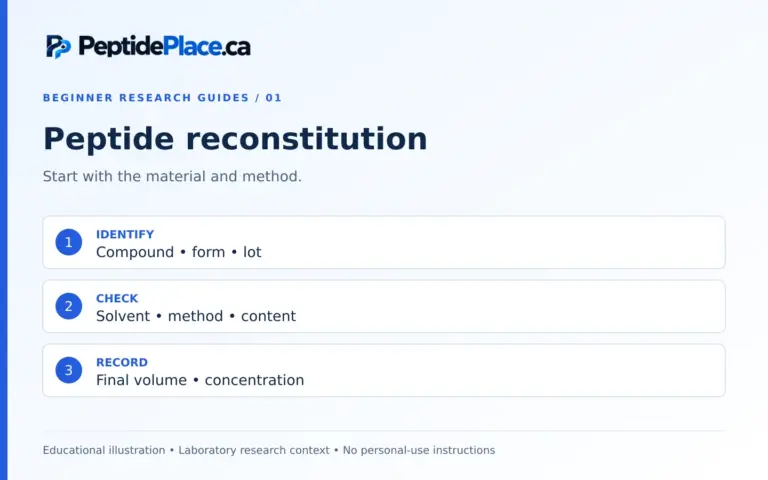
Peptide Reconstitution: A Beginner’s Research Guide
A beginner’s guide to peptide reconstitution terminology, with links to research tools, storage information and product documentation.
Read guide →
Growth Hormone Secretagogues Explained
A growth hormone secretagogue is a substance that stimulates growth hormone secretion. This is different from supplying growth hormone itself. The term is…
Read guide →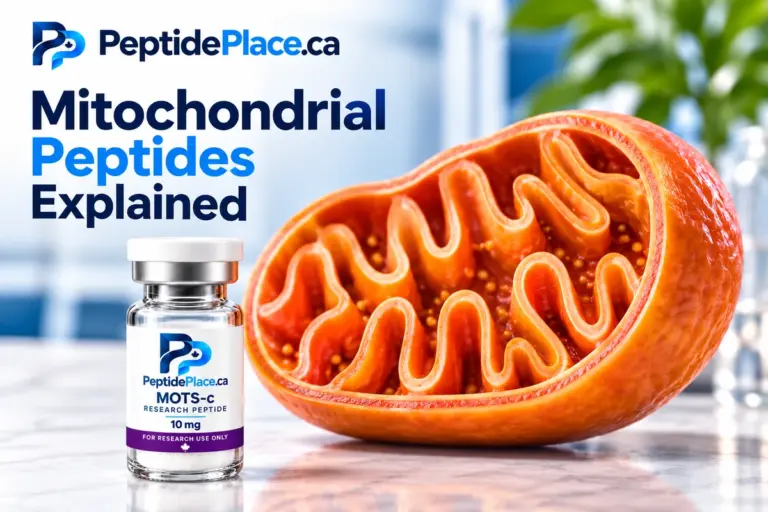
Mitochondrial Peptides Explained
Mitochondrial-derived peptides are peptides associated with sequences in mitochondrial genetic material. MOTS-c is one example discussed in cellular-energy and metabolic research. The term…
Read guide →
GHK-Cu and Collagen Research
Collagen research helps explain why GHK-Cu appears in skin-related discussions, but collagen synthesis in cultured cells and a visible skin outcome are different…
Read guide →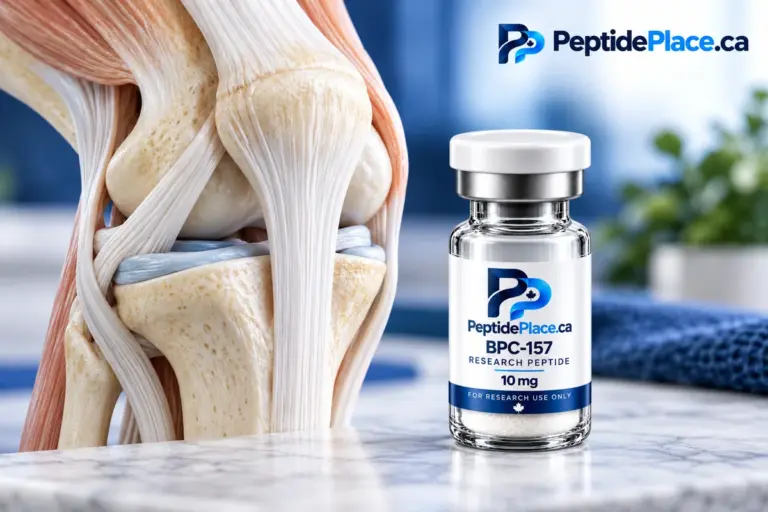
BPC-157 and Tendon Research
BPC-157 tendon research is often discussed as if every result describes recovery in a person. A more useful reading begins with the endpoint:…
Read guide →
GLP-1, GIP & Glucagon Receptors Explained
GLP-1, GIP and glucagon receptors are different biological targets involved in metabolic signalling. The familiar comparison is that semaglutide targets GLP-1 receptors, tirzepatide…
Read guide →
How to Verify Peptide Lab Reports
To verify a peptide lab report, match the sample to the product and lot, identify the issuing laboratory, confirm what method was used…
Read guide →Peptide compound research directory
Connect a familiar name with its molecular class, research question and evidence limits. Each link opens an existing profile or comparison with original sources. These are not effectiveness rankings. Sequence lengths describe reference entities, not measurements of supplied stock.
| Compound and class | Sequence length | Research path and limit |
|---|---|---|
| BPC-157 Synthetic peptide | 15 residues | Cell migration and tissue-response signalling studied experimentally; no single established clinical target should be assumed. Those experiments do not establish clinical injury recovery or the identity of supplied stock. |
| TB-500 identity Thymosin-related research name requiring an exact structure | Depends on the documented material; the cited identified fragment has 7 residues | A pathway cannot be assigned reliably from an ambiguous label alone. One analysed preparation does not define every material sold under this name. Fragment and full-length evidence are not interchangeable. |
| GHK-Cu Copper-associated tripeptide | 3 peptide residues; copper is not another amino acid | Copper association and matrix-related cell responses; a single universal clinical receptor is not established by the cited experiment. Cell-culture findings do not establish outcomes for systemic administration or every finished topical formula. |
| MOTS-c Mitochondrial-derived peptide | 16 residues | AMPK-related metabolic signalling in the cited cell and mouse work. Natural human measurements are not trials of administering MOTS-c, and mouse results do not establish human performance outcomes. |
| Retatrutide Engineered lipidated peptide | 39 residues | GIP, GLP-1 and glucagon receptor agonism. Read each formulation, population, endpoint and adverse-event record. A research product is not established as equivalent to the studied medicine. |
| Tesamorelin Growth-hormone-releasing factor analogue | 44 residues, with an N-terminal chemical modification | Growth-hormone-releasing hormone receptor pathway. That selected population and medicinal formulation do not establish general weight-loss effects or equivalence of unrelated research material. |
| Ipamorelin Synthetic growth-hormone secretagogue peptide | 5 residues | Ghrelin / growth-hormone secretagogue receptor signalling. A measured hormone response does not establish long-term performance, body-composition or safety claims. |
| KPV Tripeptide fragment related to alpha-MSH | 3 residues | PepT1-mediated uptake and inflammatory signalling in the cited experimental systems. Model-specific findings do not establish a human inflammatory-disease treatment or the finished effects of a KPV-containing blend. |
| CJC-1295 No DAC naming GHRH-related analogue label requiring a confirmed structure | 29 residues for the characterised amidated preparation in the cited analytical paper | GHRH receptor pathway for the defined analogue; attachment of DAC changes the material. The DAC clinical results must not be assigned to a No DAC preparation solely because the names overlap. |
| Tirzepatide Engineered lipidated peptide | 39 residues | GIP and GLP-1 receptor agonism. Study findings are formulation- and population-specific. Similar research names do not establish pharmaceutical equivalence. |
| GLOW Named multi-ingredient blend | No single peptide sequence or residue count | Multiple ingredient-specific pathways; no single blend receptor or verified synergy is inferred. Confirm each ingredient, quantity and chemical form. Total mass does not supply the ratio, compatibility or combination efficacy. |
| KLOW Named multi-ingredient blend | No single peptide sequence or residue count | Multiple ingredient-specific pathways; no single blend receptor or verified synergy is inferred. Confirm each ingredient, quantity and chemical form. Total mass does not supply the ratio, compatibility or combination efficacy. |
| Wolverine Named multi-ingredient blend | No single peptide sequence or residue count | Multiple ingredient-specific pathways; no single blend receptor or verified synergy is inferred. Confirm each ingredient, quantity and chemical form. Total mass does not supply the ratio, compatibility or combination efficacy. |
A related molecule that is not a peptide
NAD+ versus MOTS-c separates a dinucleotide coenzyme from a sixteen-residue peptide. Shared discussion of cellular energy does not make them interchangeable.
Continue with peptide identity, reading research or the COA checklist. Open each profile for source references and the actual study setting.